




Follow Us
Medical data shows that 3-4% of women find their babies in a breech position as they approach their due date. This news can worry expecting parents, but modern medical advances have made it safer than ever to handle a breech baby. This complete guide helps expecting parents understand everything about breech babies. You'll learn about symptoms, causes, treatment choices, and ways to prevent complications of the breech position of baby. The guide covers different types of breech baby positions and potential risks. It also explains the right time to reach out to your doctor.
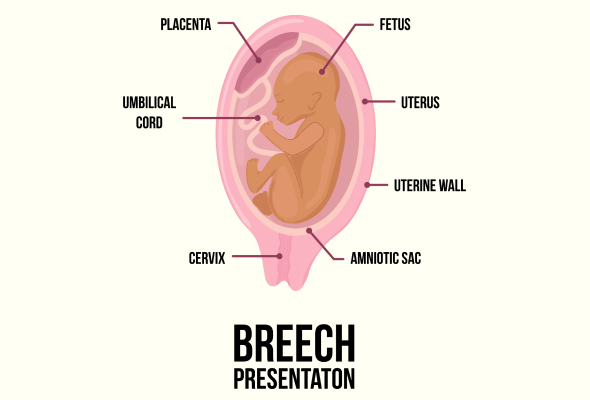
A breech baby happens when the infant's buttocks or feet lie closest to the birth canal instead of the normal head-down position. The baby's head points up toward the mother's chest, which creates a situation that needs special medical care.
Most babies move naturally into a head-down position before birth. Statistics show that only 3-5% of full-term pregnancies (37-40 weeks) result in a breech presentation. The numbers change based on how far along the pregnancy is. About 7% of babies are breech at 32 weeks, which rises to 25% at 28 weeks or earlier.
Breech presentations come with higher risks during birth. Most doctors today suggest a caesarean section for breech deliveries as the safer choice for both mother and baby. The treatment plan might change based on the specific breech baby position type, pregnancy stage, the mother's unique situation and the complications regarding the delivery of the breech baby.
Medical experts group breech positions into four main types:
The sensations can feel different from a head-down pregnancy. Here are the most common symptoms of breech baby turning:
Doctors can usually tell if a baby is breech through physical examination, especially during the third trimester. During these checkups, they press specific areas of your abdomen to check the baby's position. This check, called Leopold's manoeuvres, helps locate the baby's head, back, and buttocks.
Doctors often suggest an ultrasound scan to confirm the position. A breech baby doesn't usually cause more pain or discomfort than a head-down position. The key difference is where you feel your baby move, not how those movements feel.
Doctors often find it hard to determine exactly what causes a breach of position, but they know certain risk factors and medical conditions make it more likely. Medical conditions that can lead to a breech position include:
Some factors raise the chances of having a breech baby, including:
Vaginal breech deliveries can lead to several serious complications:
Complications Short-Term & Long-Term
Possible short-term complications may be the following:
Possible long-term complications may be:
Although the condition does not bring about any symptoms, the following indications cannot be overlooked, and one has to seek urgent medical help:
The process starts with standard physical examinations at prenatal checkups.
Doctors perform Leopold manoeuvres to check the baby's position. These hands-on techniques help them feel the abdomen and detect a complex, round structure (the baby's head) near the mother's ribs. The sensitivity of these manoeuvres ranges between 57-70%. Other tests include:
Most doctors recommend the External Cephalic Version (ECV) as the first treatment option that fits the situation.
The external Cephalic Version (ECV) helps turn the baby into a head-down position after 37 weeks of pregnancy. This procedure has shown a soaring win rate of about 60%.The procedure has its own risk. The ECV process involves:
Doctors usually present two key alternatives if ECV doesn't work or isn't suitable:
Some doctors suggest several sleeping positions to turn breech baby that patients can try at home to avoid medical procedures. These methods lack scientific proof that they work:
Women should go to emergency care if they experience:
Mothers who undergo ECV procedures should call their doctor right away if they notice:
Doctors suggest these safe practices to encourage optimal positioning:
Modern medical advances have made managing a breech baby less intimidating than you might think. Medical teams now provide several safe options for mothers facing this challenge. These options range from External Cephalic Versions to planned C-sections.
Early detection through regular prenatal checkups leads to high success rates in breech baby management. Babies born from breech presentations grow up healthy without long-term complications. This positive outcome stems from careful medical monitoring and timely interventions.
Breech positioning happens often during pregnancy. Studies show that breech babies comprise 3-4% of all full-term pregnancies. Babies commonly take this position early in pregnancy, but most will naturally shift to a head-down position before delivery.
Babies usually turn head-down between 32-36 weeks of pregnancy. Most babies take a head-down (cephalic) position by 32 weeks. Some babies might need more time to turn, and doctors observe the baby's position throughout pregnancy.
Modern medical practices have made breech births manageable, but they come with extra risks. Emergency C-sections become necessary in 40% of attempted vaginal breech deliveries. Doctors typically suggest planned C-sections to deliver breech babies safely.
You can try several methods to encourage your breech baby to turn naturally. Doctors often recommend:
Good sitting posture creates space that helps your baby turn. Your feet should stay flat on the floor with your knees below your belly. This position allows your pelvis to stay properly arranged and gives your baby more room to move.
Side sleeping works best with breech babies if you have proper support. Doctors suggest:
There may be reasons behind the breech presentation of a baby, such as the uterus shape, position of the placenta, amount of amniotic fluid, twin pregnancy, or the baby hasn't moved to the right position. But most of the time, there is no particular reason found.
The presence of a breech baby in pregnancy is mostly not a matter of concern in the initial stages of pregnancy. If your baby is breech around 36-37 weeks, then you should talk about it with your doctor.
Walking is good in pregnancy, but there isn't any proof that walking will help in turning a breech baby. Babies change their position on their own sometimes.
About 3-4 percent of full-term babies delivered are in the breech position. Breech presentation is quite common in the earlier days of pregnancy.
Do not try anything that has not been backed up by science. Do not use any exercises and positions that are too extreme and risky.
There is no proven way of preventing the baby from being in breech position. Routine check-ups during pregnancy will help determine the baby's position and the necessary treatment.
No sleeping position has been scientifically proven to turn a breech baby. Sleeping on your side in a comfortable position is usually advised when pregnant.
To Book an Appointment, call:
 +91 406 810 6585