




Follow Us
Urinary incontinence, or loss of bladder control, affects millions of people worldwide, and women and older adults face it more often than others. This health problem is more common than most people think, but many feel uncomfortable talking about it with their doctors. People who live with it often struggle with their daily activities. Unexpected urine leakage can limit your choices and activities by a lot. The constant worry about bathroom access makes it hard to live normally.
This article explains the different types of incontinence, why it happens, and ways to treat it. Learning about this condition is your first step to finding relief and taking back control, whether you have mild or severe symptoms.
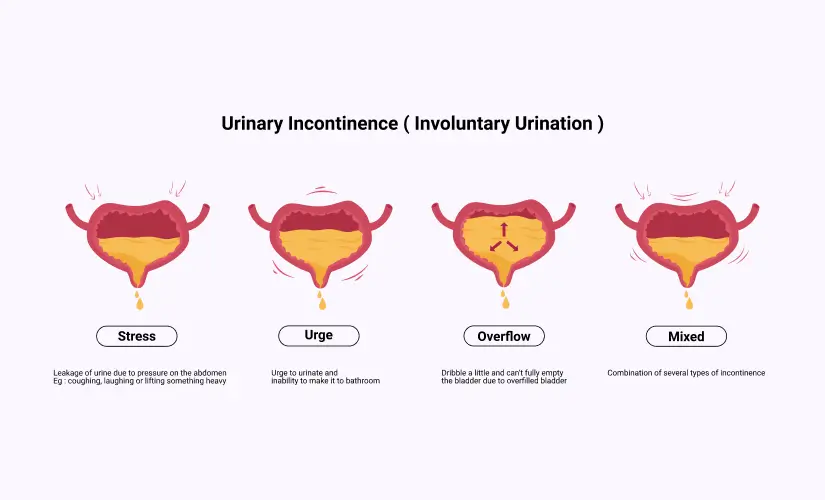
The body normally stores and passes urine in a controlled way. Urinary incontinence happens when this process gets disrupted. Some people experience minor leaks, while others face major disruptions that affect their daily activities. Incontinence of urine shouldn't be seen as a normal part of getting older. Although this is a treatable condition, many feel too embarrassed to ask for help.
Urinary incontinence comes in several distinct forms. These are
The main signs include leaks during activities. People also experience:
Any disruption in nerve signals between the brain and bladder can lead to incontinence. Several factors can trigger this condition. These include:
Women experience symptoms more often than men. Age plays a significant role, especially after 50. Other risk factors are:
Remember that aging doesn't make incontinence inevitable.
Doctors check your symptoms through physical examinations and review your medical history. They will ask about urine leakage frequency and your medication history. They will also examine the pelvic area in women & the prostate in men (for enlargement or obstruction). They might ask you to maintain a bladder diary for 2 to 3 days.
Diagnostic tests:
Basic approaches should be tried first. These are
Medications like anticholinergics or mirabegron become options if basic approaches don't help. Surgery remains an option for persistent cases.
Untreated incontinence might cause several complications. These are
Immediately consult a doctor if you experience:
You can prevent incontinence and reduce its severity by adopting healthy lifestyle habits and care practices. They are:
Daily life with urinary incontinence brings its challenges, but there's hope for anyone dealing with this condition. Many people feel shy about talking to their doctors about bladder control. However, waiting too long means missing out on solutions that work. The bright side? Most cases get better with the right treatment. Many patients see results from changing their lifestyle, doing pelvic floor exercises, and training their bladder.
Here's what matters most: you shouldn't just accept urinary incontinence as part of getting older. Good ways to manage it exist, whatever your age or situation. Talking to a doctor opens up possibilities to take back control and live better.
Better bladder health starts when you face the problem and get proper care. You shouldn't have to worry about finding bathrooms or unexpected leaks. This piece gives you a starting point to build your confidence back and enjoy your daily activities freely.
Babies press directly on the bladder while pregnancy hormones loosen pelvic floor muscles. The expanding uterus adds more pressure on the bladder and urethra, which leads to leakage. Studies show that one-third of first-time pregnant women develop stress incontinence during pregnancy.
The good news is that doctors can cure or improve most cases. Success rates depend on the type and mechanisms behind the condition.
People usually experience:
Many effective options exist before surgery becomes necessary. These include:
Urinary incontinence often affects women particularly following pregnancy, childbirth, and menopause. Changes in hormones, weaker pelvic floor muscles, and getting older all make this problem more likely to happen.
Pregnancy puts pressure on the pelvic floor, while vaginal delivery can stretch and damage these muscles and nerves. Research shows higher incontinence rates in women who deliver vaginally compared to those with caesarean deliveries.
Men experience this condition nowhere near as often as women. It is often associated with prostate enlargement, prostate surgery, ageing or nerve damage.
Urologists and urogynecologists have extensive training in bladder control issues and provide specialised treatment.



 +91 406 810 6585