Kidney cancer is increasingly detected in India as abdominal imaging becomes routine. Symptoms of kidney cancer usually appear only in later stages; therefore, routine screening becomes essential to detect it in early stages. Ramkrishna CARE Hospitals, Raipur, provides kidney cancer care spanning diagnosis, laparoscopic and open nephrectomy, targeted therapy, immunotherapy, and surveillance through a multidisciplinary team.
What Is Kidney Cancer?
Renal malignancy develops when cells in the kidney's tubular architecture lose the regulatory controls governing division and begin multiplying without limit.
Situated behind the peritoneum on either side of the spine, the kidneys filter blood, regulate electrolyte balance and secrete erythropoietin to drive red cell production. A growing malignant mass disrupts these roles and, if left untreated, extends into the renal vein, vena cava and adrenal gland. Whether the tumour originates in renal parenchymal cells or the urothelial collecting system lining determines treatment and prognosis.
Types of Kidney Cancer
Several histologically distinct tumour subtypes arise from different cell populations within the kidney and its collecting system. Common types are:
- Renal cell carcinomas (RCC): The most common type of kidney cancer, accounting for the majority of cases. It develops in the lining of the kidney's small filtering tubes.
- Clear cell renal cell carcinoma (ccRCC): It is the most common subtype of renal cell carcinoma and arises from proximal tubular cells.
- Papillary RCC: The second most common subtype of renal cell carcinoma, divided into type 1 (MET mutations) and type 2 (FH mutations) and generally carries a more favourable prognosis than ccRCC.
- Chromophobe RCC: Accounts for approximately 5% of cases and follows an indolent course with low metastatic potential.
- Transitional cell carcinoma of the renal pelvis: Arises from the urothelial collecting system lining and is managed with nephroureterectomy.
- Wilms tumour (nephroblastoma): Occurs in children under five and is treated with surgery, chemotherapy, and radiotherapy.
Kidney Cancer Symptoms
Many renal tumours remain clinically silent for years. Symptoms reflect local growth, vascular involvement, or paraneoplastic effects when they appear:
- Haematuria or visible blood in the urine is often intermittent and painless
- A palpable flank mass
- Persistent pain in the side or lower back occur as the tumour enlarges
- Unexplained weight loss without changes in diet or physical activity
- Fatigue and weakness
- Fever without an obvious infection cause
- Paraneoplastic syndromes including polycythaemia, hypercalcaemia and hypertension affect many patients
- Bone pain or neurological deficits may signal distant spread.
Causes of Kidney Cancer
Kidney cancer results from somatic mutations driven by environmental exposures and genetic susceptibilities. While the exact cause is not always known, several factors can increase the risk of developing the disease:
- Tobacco smoking is the leading environmental risk factor, conferring a higher RCC risk through renal concentration of nitrosamines and aromatic amines.
- Chronic hypertension sustains renal ischaemia and activates signalling cascades that promote tubular cell proliferation and genomic instability.
- Obesity drives RCC through hyperinsulinaemia and IGF-1 receptor activation within renal tubular cells.
- Occupational exposure to industrial chemicals (like trichloroethylene) induces gene mutations.
- People with chronic kidney disease or acquired cystic disease have a higher RCC risk.
- Certain hereditary RCC syndromes, including VHL disease, Birt-Hogg-Dubé and hereditary papillary renal cell carcinoma, are associated with a higher risk of kidney cancer.
- Kidney cancer is more commonly diagnosed in older adults.
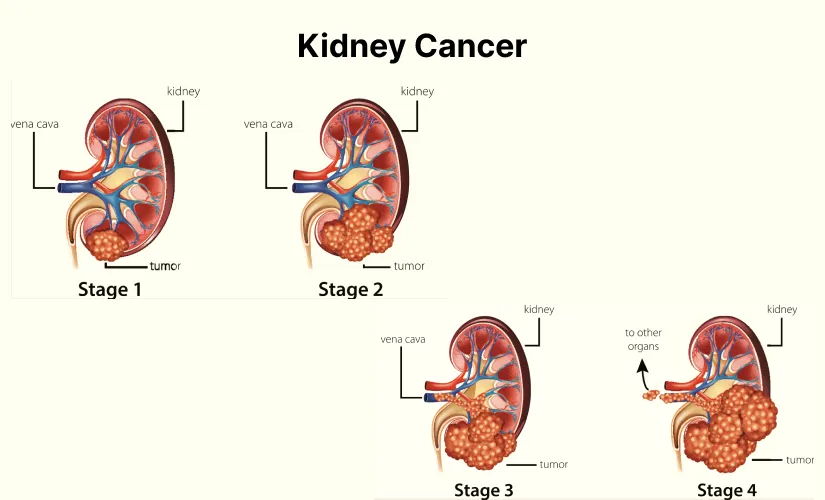
Stages of Kidney Cancer
Staging uses the TNM classification to determine treatment eligibility and predict prognosis:
- Stage I: Tumour seven centimetres or less and confined to the kidney.
- Stage II: Tumour over seven centimetres and is capsule-confined;
- Stage III: Tumour extent into the renal vein or IVC, perinephric fat invasion, or single nodal involvement.
- Stage IV: Invasion beyond the Gerota fascia or distant spread to the lungs, bones or brain.
Diagnostic Tests for Kidney Cancer
Diagnosis and staging combine biochemical and radiological and, where appropriate, histopathological assessments. Investigations are:
- Urine analysis: Detects haematuria and infection.
- Renal function tests: Check creatinine, eGFR and electrolyte levels.
- Contrast-enhanced CT: It is the primary staging modality used for diagnosing kidney cancer, providing detailed information about the tumour and its spread.
- MRI: Offers superior IVC thrombus assessment and is preferred when CT contrast is contraindicated.
- CT chest and bone scintigraphy: Evaluate pulmonary and skeletal metastasis in locally advanced or symptomatic disease.
- Percutaneous renal biopsy: Under CT or ultrasound guidance, a biopsy is performed selectively when imaging is non-diagnostic or histological subtype confirmation is needed before systemic therapy.
Risk of Kidney Cancer
Risk factors span modifiable lifestyle variables, chronic medical conditions and inherited genetic syndromes:
- Cigarette smoking doubles RCC risk and the risk is dose-dependent and partially reversible with sustained cessation over ten or more years.
- BMI above 30 independently increases RCC risk by a lot
- Hypertension, male sex, age above 60, first-degree family history, and long-term phenacetin analgesic use each confer additional independent risk.
Complications of Kidney Cancer
Advanced kidney cancer produces organ-threatening complications from tumour growth and vascular invasion. They are:
- Haemorrhage into the collecting system or retroperitoneum
- IVC tumour thrombus risks pulmonary embolism
- Skeletal metastases cause pathological fractures, bone pain and spinal cord compression
- Hypercalcaemia can precipitate renal failure, arrhythmia and altered consciousness
- Pulmonary metastases impair respiratory function
- Brain metastases carry a poor prognosis and may present with seizures, focal deficits, or raised intracranial pressure.
Treatment for Kidney Cancer
Treatment is selected by tumour stage, histological subtype and renal function:
- Radical nephrectomy: Removal of the kidney, Gerota's fascia, and adrenal gland is standard for T2 or larger tumours and is performed minimally invasively or via open loin incision.
- Partial nephrectomy: Preferred for T1 tumours and in patients with a solitary kidney or compromised contralateral function. The procedure preserves renal tissues & reduces long-term renal complications.
- RFA or cryoablation: The specialist uses image-guided probes to deliver thermal or freeze injury, and it is preferred for masses under three centimetres in patients unfit for surgery.
- Targeted Therapy: This advanced therapy uses specific medicines to block pathways that stimulate cancer cell growth. These treatments are commonly used for advanced or metastatic kidney cancer.
- Immunotherapy: Specific drugs stimulate the body's immune system to recognise & attack cancer cells and are the preferred first-line standard for intermediate- and poor-risk metastatic RCC.
- Cytoreductive nephrectomy: Performed selectively in patients with good performance status and limited metastatic burden, enhancing the efficacy of subsequent systemic therapy.
Prevention of Kidney Cancer
Prevention targets the modifiable risk factors carrying the greatest attributable fraction for kidney cancer:
- Smoking cessation reduces kidney cancer risk toward baseline over a decade and is the most impactful preventive measure.
- Weight management targeting a BMI below 25 reduces hyperinsulinaemic stimulants of renal tubular proliferation.
- Blood pressure control with medicine reduces chronic renal ischaemia and mutagenic burden.
- Those with hereditary RCC syndromes require annual renal imaging from early adulthood and genetic counselling for at-risk family members.
Why Choose Ramkrishna CARE Hospitals for Kidney Cancer Treatment in Raipur?
Ramkrishna CARE Hospitals, Raipur, runs a urological oncology service where surgeons, oncologists, radiologists and pathologists review every case through a structured tumour team. Laparoscopic and robotic-assisted radical and partial nephrectomy use high-definition optics and dissection instruments; the surgical unit manages IVC thrombus cases and the interventional team supports percutaneous ablation for patients unfit for surgery.
Systemic therapy is delivered under close monitoring, with surveillance imaging, renal function assessment and palliative care embedded in the post-treatment pathway. Patients across Chhattisgarh access this full spectrum of care locally.