Lung cancer leads cancer mortality worldwide and ranks third in incidence in India. Tobacco smoking drives most cases, though adenocarcinoma in non-smoking women is rising in Indian urban populations. In Chhattisgarh industrial dust, biomass combustion and tobacco use together produce varied lung cancer symptoms. Ramkrishna CARE Hospitals, Raipur, delivers lung cancer care through bronchoscopy, biopsy, surgery, radiation, chemotherapy, targeted therapy and immunotherapy within a single integrated centre.
What Is Lung Cancer?
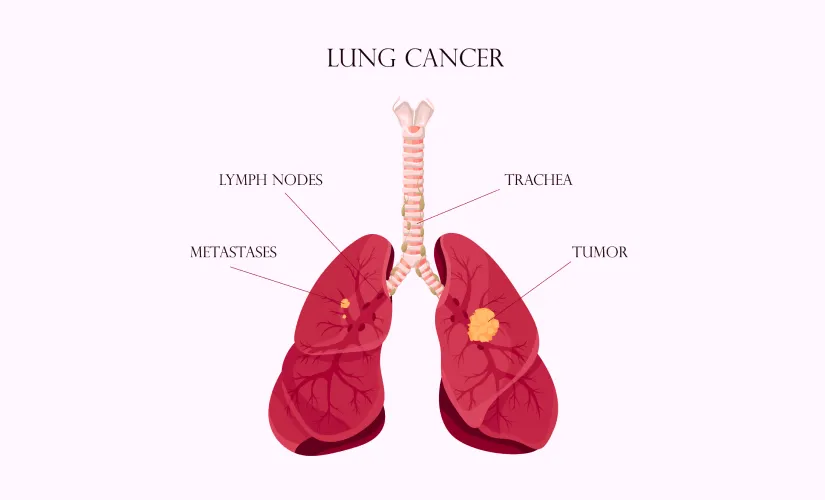
Lung cancer develops when airway or alveolar cells accumulate mutations and start growing uncontrollably, forming masses. Over time the tumour can grow, invade nearby tissues and spread to other parts of the body. Two categories are:
- Non-small Cell Lung Cancer (NSCLC): Adenocarcinoma, squamous cell carcinoma, and large cell carcinoma account for 85% of all lung cancer
- Small Cell Lung Cancer (SCLC): Comprises 15%, grows rapidly and metastasises early. Establishing the category and molecular subtype is the foundation of every treatment decision.
Types of Lung Cancer
Lung cancer is classified by cell of origin, determining prognosis and therapy selection. Common types are:
- Adenocarcinoma: The most common type of lung cancer. It usually develops in the outer parts of the lungs and is more frequently seen in non-smokers and former smokers.
- Squamous cell carcinoma: Originates from central bronchial epithelium and is strongly linked to smoking
- Large cell carcinoma: A less common but aggressive form of non-small cell lung cancer that can develop anywhere in the lungs and tends to grow and spread quickly
- Small Cell Lung Cancer (SCLC): A fast-growing type strongly associated with smoking. It tends to spread early and is usually treated with a combination of chemotherapy, immunotherapy, and radiation therapy.
- Pulmonary carcinoid tumours: These rare tumours are slow-growing with a substantially better prognosis.
Symptoms of Lung Cancer
In stage 1 lung cancer symptoms are usually subtle. Patients present with symptoms when tumour growth encroaches on the airways, vessels or mediastinal structures:
- A new cough persisting more than three weeks, or a change in a smoker's chronic cough, is the most common complaint and should not be attributed to infection without investigation.
- Haemoptysis ranging from blood-streaked sputum to frank bleeding
- Progressive breathlessness arises from airway obstruction, malignant pleural effusion, or phrenic nerve invasion.
- Dull persistent chest pain worsened by inspiration indicates pleural involvement, and sharp positional pain may reflect pericardial spread.
- Weight loss, fatigue, anorexia, SVC syndrome, hoarseness, Horner syndrome and brachial plexus arm pain are signs of advanced local and mediastinal disease.
Causes of Lung Cancer
Lung cancer results from stepwise somatic mutations in bronchial cells, driven by carcinogen exposure and genetic susceptibility. Other factors responsible for lung cancer causes are the following:
- Tobacco smoking is the most common reason for lung cancers and even secondhand smoke raises non-smoker risk by a lot
- Radon gas exposure is the second leading global cause.
- Occupational asbestos, silica, and arsenic multiply the risk combined with tobacco.
- Indoor biomass combustion drives adenocarcinoma in non-smoking women.
Lung Cancer Stages
NSCLC is staged by the eighth edition TNM system, whereas SCLC uses a limited versus extensive disease classification.
- Stage I: The cancer is confined to the lung and has not spread
- Stage II: The tumour is larger or has spread to nearby lymph nodes
- Stage III: The cancer has spread to lymph nodes in the centre of the chest (mediastinal nodes) or nearby tissues and may involve surrounding structures such as the chest wall, diaphragm, or major airways
- Stage IV: The cancer has spread beyond the chest to distant organs such as the liver, brain, bones, or adrenal glands.
SCLC classification:
- Limited-stage disease: Confined to one side of the chest
- Extensive-stage disease: Cancer has spread beyond the original lung or to distant parts of the body.
Diagnostic Tests for Lung Cancer
Diagnosis and staging combine tissue histology, molecular profiling and cross-sectional imaging:
- Chest X-ray: Identifies pulmonary masses, pleural effusion or mediastinal widening but misses tumours under one centimetre.
- Contrast-enhanced CT: CT of the thorax, abdomen, and pelvis is the primary staging modality
- Bronchoscopy: EBUS-TBNA bronchoscopy accesses central tumours and samples mediastinal nodes without open surgery.
- CT-guided biopsy: Provides peripheral lesion tissue
- PET-CT with FDG: Detects occult metastases
- Molecular profiling: Assesses EGFR, ALK, ROS1, PD-L1 and TMB from tissue or ctDNA is mandatory before systemic therapy.
Risk of Lung Cancer
Risk stratification identifies individuals who benefit most from screening and prevention:
- Heavy smokers aged 50 to 80 with 20 or more pack-years carry the highest risk & are the primary LDCT screening target.
- Occupational asbestos or silica exposure, indoor biomass combustion, radon, COPD, pulmonary fibrosis and first-degree family history each independently elevate risk.
Complications of Lung Cancer
Advanced lung cancer produces wide-ranging complications driven by tumour spread and vascular invasion.
- Malignant pleural effusion causes breathlessness
- Spinal cord compression from vertebral metastasis presents with pain, weakness and sphincter dysfunction
- Brain metastases
- Post obstructive pneumonia from bronchial blockage
- Hypercalcaemia
- Osteolytic metastasis causes confusion, polyuria, and arrhythmia.
Treatment for Lung Cancer
Treatment is determined by histological subtype, molecular profile and stage:
- Surgery: Video-assisted thoracoscopic surgery (VATS) or open lobectomy is the first-line treatment for many patients with early-stage non-small cell lung cancer. Doctors recommend additional chemotherapy or targeted therapy after surgery to reduce the risk of recurrence.
- Stereotactic ablative radiotherapy (SABR): SABR given in 3 to 5 fractions achieves local control in medically inoperable stage I cancer.
- Chemotherapy: The doctor recommends this before or after surgery or as a primary treatment for advanced lung cancer & small cell lung cancer. Doctors recommend concurrent chemoradiotherapy for unresectable stage III lung cancer.
- Targeted therapy: Doctors recommend targeted drugs for lung tumours that carry specific genetic alterations.
- Immunotherapy: Immune checkpoint inhibitors are used alone or in combination with chemotherapy for advanced NSCLC and SCLC.
Prevention of Lung Cancer
Prevention centres on eliminating tobacco exposure and reducing occupational and environmental carcinogen burden.
- Cessation reduces risk from the first year with further decline each decade thereafter.
- Workplace carcinogen controls and transitioning from solid biomass cooking to LPG or electric stoves are the primary occupational and household prevention strategies.
- Annual LDCT (Low dose computed tomography) in high risk adults aged 50 to 80 with 20 or more pack-years reduced lung cancer chances.
Why Choose Ramkrishna CARE Hospitals for Lung Cancer Treatment in Raipur?
Ramkrishna CARE Hospitals, Raipur operates a thoracic oncology programme with weekly tumour team review by surgeons, pulmonologists, oncologists and pathologists. Our experts perform VATS lobectomy and advanced procedures like endobronchial ultrasound guided transbronchial needle aspiration (EBUS-TBNA) to diagnose and treat lung cancers.
Molecular profiling for EGFR, ALK, ROS1 and PD-L1 is processed in our hospital, enabling personalised treatment without referral delays. Systemic therapy is delivered in a dedicated day-care unit and patients across Chhattisgarh access this spectrum of care locally.