Cervical cancer is the second most common cancer in Indian women despite being largely preventable through vaccination and screening. Most women present at an advanced stage due to a lack of awareness and delayed detection. Early diagnosis can improve treatment outcomes and survival rates by a lot. At Ramkrishna CARE Hospitals, Raipur, a multidisciplinary oncology team delivers evidence-based cervical cancer care.
What is Cervical Cancer?
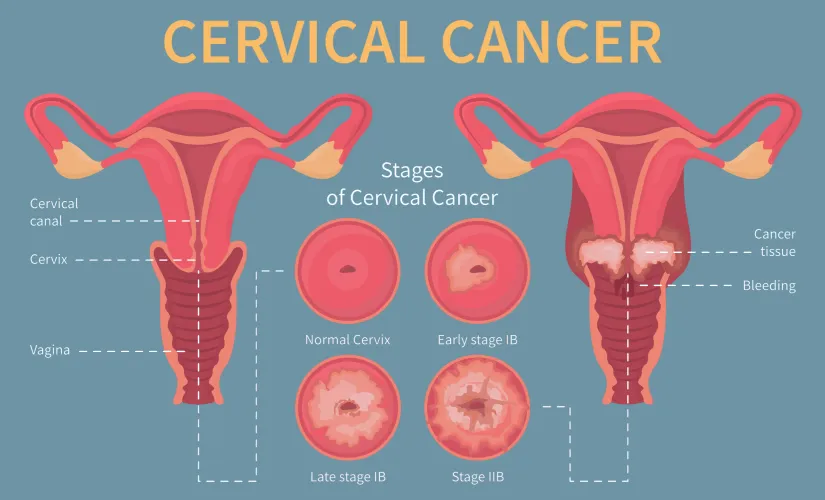
Cervical cancer arises from the lining of the cervix - the lower end of the uterus. The transformation zone between the squamous ectocervix and the columnar endocervix is where the vast majority of cancers begin.
Most cervical cancers develop gradually through precancerous carcinoma in situ (CIN) stages I to III. CIN may not cause symptoms but can be detected through regular screening tests. CIN I usually resolves spontaneously while CIN II and III require treatment. This 10 to 15-year window before invasive cancer is precisely why screening is so effective.
Symptoms of Cervical Cancer
Sometimes in the initial stages, cervical cancer doesn't show any symptoms. But when it does, common cervical cancer symptoms are
- Abnormal vaginal bleeding, including intermenstrual bleeding, postcoital bleeding, postmenopausal bleeding, and heavy periods, is the most common presenting symptom.
- Unusual vaginal discharge that is watery, blood-tinged, or foul-smelling results from tumour necrosis.
- Pelvic pain, a dull lower abdominal ache that worsens during or after intercourse
- Urinary or bowel symptoms develop when the tumour invades adjacent structures such as the bladder or rectum.
- Leg swelling and loin pain occur in advanced disease from lymph node obstruction or ureteric compression.
Causes of Cervical Cancer
HPV 16 and HPV 18 integrate into host cell DNA, inactivating tumour suppressor genes. HPV 16 accounts for 50 to 60% of cervical cancers, and HPV 18 accounts for a further 10 to 15%. Other cervical cancer causes are the following:
- Multiple sexual partners and early sexual debut increase cumulative HPV exposure throughout a woman's life
- HIV-positive women have a higher cervical cancer risk, and long-term immunosuppressive therapy elevates risk markedly.
- Smoking impairs local immune responses, increasing the likelihood of persistent HPV infection.
- Co-infection with chlamydia or herpes simplex may further increase cancer risk in HPV-positive women.
Cervical Cancer Staging
Cervical cancer is staged using the FIGO system which determines treatment and prognosis:
- Stage I: Cancer is confined to the cervix (IA microscopic; IB1 under 2 cm; IB2 2 to 4 cm; IB3 above 4 cm).
- Stage II: Extends beyond the cervix but does not reach the pelvic wall.
- Stage III: Reaches the pelvic wall or causes hydronephrosis
- Stage IIIC: This involves regional lymph nodes.
- Stage IV: Involves the bladder or rectum (IVA) or distant metastases (IVB).
Diagnostic Tests for Cervical Cancer
A Pap smear detects CIN and early cancer and is recommended every 3 years from age 21 or every 5 years with HPV co-testing. Investigations include:
- HPV DNA testing: It is more sensitive than a Pap smear alone and detects high-risk strains. Combined co-testing is preferred for women over 30.
- Colposcopy: Provides magnified examination; acetic acid turns precancerous areas white, and targeted biopsies are taken.
- Cervical biopsy (punch or LLETZ/LEEP): It is the definitive test confirming cancer type and grade.
- MRI pelvis: Defines tumour size, parametrial involvement, and lymph node status for staging.
Risk of Cervical Cancer
- Persistent high-risk HPV infection is the most important risk factor; most infections clear in 1 to 2 years, but persistence of HPV 16 or 18 substantially increases cancer risk. Other risk factors are:
- Never having been screened is the most preventable risk factor; unscreened women are far more likely to present with advanced-stage disease.
- HIV and immunosuppression raise cervical cancer risk 5 to 10 times.
- Smoking doubles squamous cell cervical cancer risk in HPV-positive women.
Complications of Cervical Cancer
If left untreated, cervical cancer can cause the following:
- Bilateral ureteric obstruction causes hydronephrosis and renal failure
- Vesico-vaginal or recto-vaginal fistula forms when tumour invades the bladder or rectum, causing continuous leakage.
- Severe haemorrhage from tumour erosion of pelvic vessels
- Lymphoedema and chronic leg swelling.
- Sexual dysfunction, including vaginal dryness and stenosis, is common after surgery or radiotherapy.
Cervical Cancer Treatment
Treatment depends on the symptoms and stage of cervical cancer:
- Stage IA1 is treated by cone excision (LLETZ or LEEP), which is curative. A simple hysterectomy is offered to women who have completed their family.
- Stage IA2 and IB1 is treated by radical hysterectomy with or without adjuvant radiotherapy or by concurrent chemoradiotherapy with equivalent outcomes. Radical trachelectomy preserves the uterus while removing the cervix and is an option for selected Stage IA2 to IB1 tumours under 2 cm in women wishing to conceive.
- Stage IB2 to IIA is preferentially treated with chemoradiotherapy for tumours above 4 cm, though radical surgery remains an alternative.
- Stage IIB to IVA is treated with concurrent chemoradiotherapy (external beam radiotherapy with weekly chemotherapy) followed by intracavitary brachytherapy.
- Stage IVB and recurrent disease are treated with chemotherapy with immunotherapy for PD-L1-positive recurrent cancer; palliative radiotherapy controls haemorrhage and pain.
Prevention of Cervical Cancer
Preventive steps are:
- Vaccination protects against HPV strains responsible for cervical cancers. Vaccination before the start of sexual activity provides maximum protection.
- Cervical screening detects precancerous CIN before it progresses. Doctors suggest a Pap smear every 3 years from age 21 or HPV co-testing every 5 years from age 30.
- Smoking cessation reduces cervical cancer risk and improves response to surgery and radiotherapy.
- Women with HIV should receive antiretroviral therapy and be screened every 6 to 12 months.
Why Choose Ramkrishna CARE Hospitals for Cervical Cancer Treatment in Raipur?
Ramkrishna CARE Hospitals is the most comprehensive cancer centre in Chhattisgarh, offering the full spectrum of cervical cancer care from prevention through to surgery, chemoradiotherapy, brachytherapy, immunotherapy and palliative care. Our gynaecological oncology team performs radical hysterectomy, trachelectomy and laparoscopic surgery; radiation oncology delivers EBRT and brachytherapy to international protocols; and medical oncology provides chemotherapy and immunotherapy.
Patients choose us for our multidisciplinary tumour team, advanced imaging, on-site colposcopy and pathology, cancer counselling and cashless insurance support. Early cervical cancer is curable; women with advanced disease receive expert palliative care.