Prostate cancer is the most diagnosed male urological malignancy in India. Ranging from inactive tumours managed by surveillance to aggressive cancers demanding multimodal therapy, late presentation with urinary obstruction or bone pain remains common. Ramkrishna CARE Hospitals, Raipur delivers prostate cancer care including understanding of prostate cancer symptoms, PSA screening, multiparametric MRI, biopsy, robotic surgery, radiation, hormonal therapy, and systemic treatment through a specialist uro-oncology unit.
What Is Prostate Cancer?
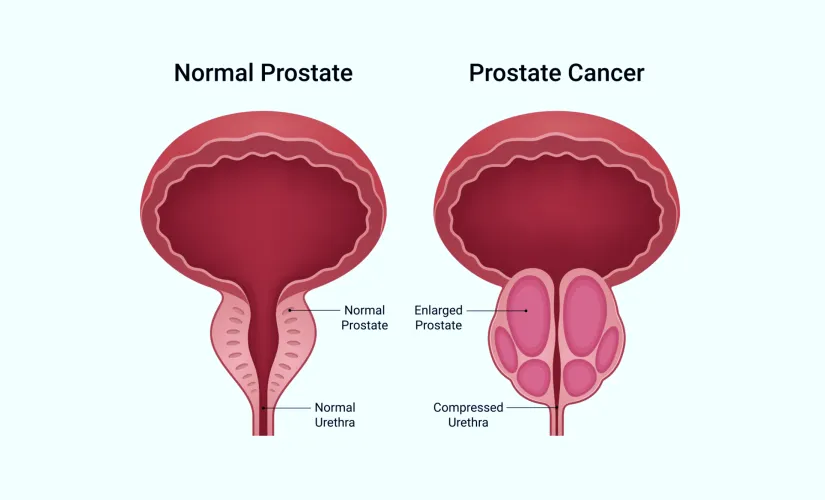
Prostate cancer arises when cells in the prostate gland start multiplying uncontrollably and form a tumour. The prostate is a small gland situated just below the bladder, responsible for producing part of the seminal fluid. Most prostate cancers originate in the glandular cells that line the prostate and tend to grow slowly in the early stages.
Most cancers arise in the peripheral zone and extend through the capsule into seminal vesicles and lymph nodes before metastasising to the axial skeleton. Early detection changes the picture significantly. When caught in time, treatment can control the disease effectively and, in many cases, leads to successful long-term outcomes.
Types of Prostate Cancer
Most prostate cancers share a single histological origin and distinct subtypes differ in biological behaviour and treatment response:
- Adenocarcinoma: The most common form of prostate cancer, arising from the glandular cells that produce prostate fluid.
- Ductal adenocarcinoma: A less common subtype that develops in the ducts of the prostate gland. It tends to behave more aggressively and can be harder to detect early.
- Transitional cell carcinoma: A rare cancer that originates in the cells lining the urinary tract and may extend to involve the prostate. It is more commonly associated with bladder cancer.
- Squamous cell carcinoma: An uncommon and aggressive type that develops from the flat cells found within the prostate rather than the glandular tissue.
- Small cell carcinoma: A rare neuroendocrine tumour that grows rapidly and has a tendency to spread early, often before symptoms become apparent.
- Neuroendocrine tumours: A group of uncommon prostate cancers arising from neuroendocrine cells. Their behaviour varies, with some growing slowly and others proving significantly more aggressive.
- Sarcoma: A very rare form that develops from the connective tissues, muscles or blood vessels of the prostate rather than the epithelial cells.
Symptoms of Prostate Cancer
Early prostate cancer is silent. Symptoms appear when tumour growth compresses the urethra, invades local structures or metastases establish. Common symptoms are:
- Lower urinary tract symptoms (LUTS) including hesitancy, poor stream, frequency and nocturia
- Haematuria, haematospermia or new erectile dysfunction can reflect perineural invasion
- Bone pain in the lumbar spine, pelvis or hips is the cardinal symptom of skeletal metastasis
- Lower limb weakness and sphincter loss indicate cauda equina compression
- Weight loss and anaemia reflect marrow-infiltrating advanced disease.
Prostate Cancer Causes
Prostate cancer develops through somatic mutations in prostatic epithelial cells driven by hormonal, genetic, and environmental factors:
- Hormonal influence: Testosterone and its more potent derivative DHT are the primary drivers of prostate cell growth. Prolonged hormonal signalling can trigger mutations in prostate cells that eventually lead to cancer.
- Genetic factors: Inherited mutations in the BRCA2 gene carry an increased lifetime risk of developing high-grade, early-onset prostate cancer. Mutations in BRCA1, ATM and CHEK2 also raise hereditary risk.
- Chronic inflammation: Persistent inflammation within the prostate produces reactive oxygen species & unstable molecules that damage DNA over time and create conditions where cancerous changes are more likely to occur.
- Diet and lifestyle: A diet high in saturated fat elevates levels of IGF-1, a growth-promoting hormone linked to increased cancer risk. On the other hand diets rich in lycopene, a natural compound found in tomatoes and other red fruits are associated with a measurably lower risk of prostate cancer.
Stages of Prostate Cancer
Prostate cancer staging combines TNM, PSA level and Gleason Grade Group into NCCN and EAU risk stratification. Stages are
- Stage I (localised, Grade Group 1, PSA under 10): active surveillance is standard.
- Stage II (intermediate-risk, PSA 10 to 20, Grade Group 2 to 3): prostatectomy or radiotherapy with or without a short course of ADT is recommended.
- Stage III (locally advanced, extracapsular extension): radiotherapy with 18 to 36 months of ADT is standard.
- Stage IV (metastatic - nodal, bone or visceral): ADT combined with chemotherapy or targeted therapy is standard.
Prostate Cancer Diagnosis
Diagnosis integrates serum biomarkers, imaging and tissue biopsy to establish tumour extent and aggressiveness:
- Serum PSA above 4.0 nanograms per millilitre (or 3.0 in high-risk individuals) needs evaluation
- DRE detects hard posterior nodules and improves detection sensitivity when combined with PSA.
- Multiparametric MRI (mpMRI) identifies clinically significant cancer
- Bone scintigraphy detects skeletal metastases
- PSMA PET-CT is the staging standard in high-risk and recurrent cancer.
- Germline testing for BRCA1/2, ATM, CHEK2 and mismatch repair genes is recommended in high-risk, metastatic, or early-onset cases.
Risk of Prostate Cancer
Several clinical and biological factors significantly elevate a man's lifetime risk of prostate cancer.
- Age is the strongest risk factor and incidence rises sharply after 50, peaks in the seventh decade
- African ancestry confers two to threefold higher incidence
- A first degree family history doubles lifetime risk, rising further with early-onset or multiple affected relatives.
Complications of Prostate Cancer
Advanced prostate cancer produces debilitating complications that require specialist management:
- Fractures & spinal cord compression
- Ureteric obstruction from pelvic disease causes hydronephrosis
- Anaemia
- Castration-resistant prostate cancer (CRPC).
Treatment for Prostate Cancer
Treatment is guided by risk group, stage, PSA kinetics, comorbidity, and patient preference through multidisciplinary discussion:
- Active surveillance: PSA every three to six months, annual DRE and repeat MRI with confirmatory biopsy is standard for Grade Group 1 low-risk disease
- Radical prostatectomy: Open, laparoscopic or robotic-assisted (RARP) prostatectomy removes the prostate, seminal vesicles and pelvic lymph nodes. RARP reduces blood loss and facilitates nerve-sparing.
- Radiation Therapy: Intensity-modulated radiation therapy (IMRT) or volumetric modulated arc therapy (VMAT) with or without high dose rate brachytherapy boost delivers curative-intent radiation. When combined with long course ADT in locally advanced disease, it achieves outcomes equivalent to surgery.
- ndrogen deprivation therapy (ADT): LHRH agonists or antagonists suppress testosterone and when combined with AR inhibitors, it significantly prolongs survival in metastatic hormone-sensitive disease.
- Advanced targeted therapy: Androgen receptor signaling inhibitors treat castration-resistant and hormone-sensitive metastatic disease;
Prevention of Prostate Cancer
No intervention is approved for prostate cancer chemoprevention, but lifestyle modification substantially reduces risk:
- Aerobic exercise exceeding 150 minutes weekly reduces hyperinsulinaemia and IGF-1 signalling, and is associated with a lower risk of advanced prostate cancer.
- Diets rich in cooked tomatoes, cruciferous vegetables, soy isoflavones, and green tea polyphenols are associated with reduced prostate cancer incidence.
- Avoiding tobacco, limiting alcohol, and reducing processed meat address inflammatory drivers of prostatic damage.
- Men with a family history or BRCA2 mutation should begin PSA screening at age 40.
Why Choose Ramkrishna CARE Hospitals for Prostate Cancer Treatment in Raipur?
Ramkrishna CARE Hospitals, Raipur, runs a uro-oncology service with a weekly multidisciplinary tumour board review. On-site multiparametric MRI and PSMA PET support staging; robotic-assisted prostatectomy is the surgical standard with the nerve-sparing technique in eligible men.
Intensity-modulated Radiation Therapy (IMRT) with daily image guidance conforms the dose to the prostate. ADT and targeted therapy are delivered in a day-care unit under expert monitoring; bone health with regular DEXA scanning is integrated for patients on long-term ADT. Patients across Chhattisgarh access this care locally.