



-
Centre of Excellence
Specialties
Treatments and Procedures
 HyderabadCARE Hospitals, Banjara Hills CARE Outpatient Centre, Banjara Hills CARE Hospitals, HITEC City CARE Hospitals, Nampally Gurunanak CARE Hospitals, Musheerabad CARE Hospitals Outpatient Centre, HITEC City CARE Hospitals, Malakpet
 Raipur
 Bhubaneswar
 Visakhapatnam
 Nagpur
 Indore
 Chh. Sambhajinagar
 Clinics & Medical Centers


-

-

-

-

-

-
Follow Us

Benign Prostatic Hyperplasia (BPH) Treatment in Hyderabad

Chat With Our Experts
Get second opinion on Whatsapp
Prostate enlargement, which is also called benign prostate enlargement or benign prostatic hyperplasia (BPH), is the condition seen in men after the age of 50. Prostate enlargement causes the gland to press against the urethra, leading to uncomfortable urinary symptoms that primarily disrupt daily routines, sleep, regular activities, and overall quality of life.
Early diagnosis helps doctors to treat the enlargement of the prostate gland using effective treatment techniques. CARE Hospitals offers comprehensive advanced medical care for the enlargement of the prostate, which works to minimize symptoms, ensure long-term results, and restore urinary function.
Our team of urologists in Hyderabad designs treatment programs for the enlargement of the prostate using advanced diagnostic techniques and the most effective methods to suit the health needs and lifestyle patterns of patients.
Why Choose CARE Hospitals for Prostate Enlargement Treatment in Hyderabad?
It is very crucial while choosing the hospital for the treatment of an enlarged prostate gland. CARE Hospitals is one of the reputed hospitals in Hyderabad for the treatment of an enlarged prostate gland. Here are some reasons why CARE Hospitals is considered to be an excellent hospital:
- Experienced urologists who can deliver a correct diagnosis and treatment for enlarged prostates.
- Using advanced diagnostic tools, such as uroflowmetry, ultrasound, and PSA test results, to correctly identify the exact size of the prostate gland.
- Providing multiple treatment options for prostate enlargement.
- Creating a special individualized patient treatment plan based on the condition of the patient.
- Employing less invasive procedures, as well as laser treatments, which facilitate speedy recovery.
- The total care of the patient, i.e., from the time of the arrival of the patient to the time of the recovery.
What is Prostate Enlargement?
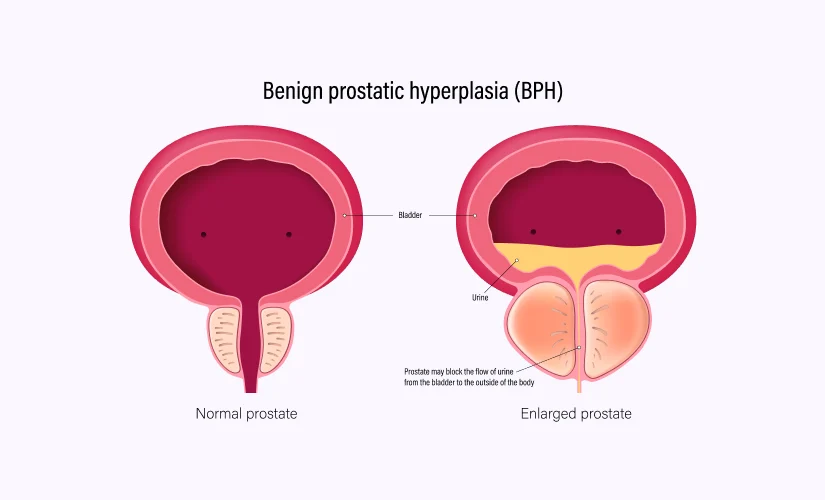
Prostate enlargement is the non-cancerous growth of the prostate gland, a walnut-sized gland located below the bladder in men. This condition could also be referred to as benign prostatic hyperplasia, or BPH.
As the prostate gland enlarges, it presses against the urethra, thereby interfering with urine flow. While not cancerous, if the symptoms are not treated, they can have a greater effect on one's life.
Prostate Enlargement Symptoms
Symptoms of prostate enlargement often develop gradually and may become progressively worse over time. These may include:
- Increased Frequency of Urination: Men may experience the urge to urinate more often than before, especially during the night (referred to as nocturia). This can disrupt their sleep cycle.
- Difficulty Initiating Urination: This is often due to straining or hesitating when starting to urinate.
- Decreased Flow of Urine: Some men may have a decreased flow or a persistent interruption when urinating due to obstruction caused by the enlarged prostate.
- Feeling Like the Bladder Isn’t Empty: Many men will report feeling that their bladder did not fully empty after urinating.
- Urinary Urgency: This is considered one of the common symptoms, and the individual experiences a strong urge to urinate.
Causes of Prostate Enlargement
It is important to know what the main cause of prostate enlargement is. While the exact reason is not fully understood, the following factors contribute to this condition:
- Hormonal Changes with Aging: Imbalances in hormones due to aging are the leading cause of prostate gland enlargement.
- Testosterone and DHT Levels: Levels of male hormones, especially dihydrotestosterone (DHT), cause the prostate gland to enlarge with time.
- Genetic Factors: Men who have a genetic predisposition to prostate gland enlargement in their family may be at a higher risk of developing BPH.
- Lifestyle Factors: Obesity, a sedentary lifestyle, and unhealthy eating habits can contribute to worsening symptoms of an enlarged prostate gland.
Prostate Enlargement Complications
If left untreated, prostate enlargement (BPH) might develop the following complications:
- Acute Urinary Retention—If one cannot pass urine at all due to the block, it could be an emergency situation.
- Recurrent Urinary Tract Infections—Over a period, if the bladder does not empty completely, bacteria will continue to build up and may lead to frequent and painful urinary tract infections.
- Bladder Stones—When urine is left in the bladder after urinating, it forms solid masses known as renal stones. These renal calculi (stones) can cause pain, irritation, and difficulty urinating.
- Kidney Damage (Most Severe)—Continual pressure from a blocked urinary tract will put pressure on the kidneys, and if not treated in a timely manner, this may lead to kidney function being reduced.
- Decreased Quality of Life—Continuous urinary symptoms may prevent one from sleeping, completing daily activities, or generally feeling well—both physically and emotionally.
Early medical intervention plays a major role in managing the BPH, and helps in preventing these complications.
Prostate Gland Enlargement Treatment Options
The treatment for prostate enlargement (benign prostatic hyperplasia) is based on the severity of symptoms, prostate size, overall health, and how much the condition affects daily life. CARE Hospitals offers a step-by-step, personalized approach to ensure effective relief with the least discomfort.
- Observation (Watchful Waiting): Men who have mild symptoms and do not experience significant disruption to their everyday lives may not need immediate medical treatment. In many cases, periodic check-ups and changing certain aspects of your lifestyle (e.g., limiting your fluid intake in the evening, cutting back on caffeine and alcohol) can allow you to control your symptoms in a safe manner.
- Medications: For men who have moderate symptoms, medications are often the first line of therapy. Alpha blockers help to relax the muscles of the prostate and bladder neck, making it easier for urine to flow. 5-alpha reductase inhibitors shrink the prostate gland over time. Sometimes a combination of these two types of medications may be used to provide optimal symptom relief as well as long-term management of your prostate enlargement.
- Surgical Procedures
- Transurethral Resection of the Prostate (TURP): TURP is the most common surgical procedure for treating moderate to severe benign prostatic hyperplasia (BPH). TURP involves removing the excess tissue responsible for urinary obstruction via the urethra (without creating an incision on the outside of the patient's body), providing long-term relief from symptoms and significantly improving urine flow.
- Laser Prostate Surgery: In this surgery, high-intensity, focused laser beams are employed to remove or vaporize the enlarged tissues in the prostate area. The advantages of these surgical procedures are that they result in little or no loss of blood, reduce the patient's hospital stay, and enhance the recovery period. Therefore, it is an excellent option for older patients, particularly if they are taking blood-thinning medicine.
- Holmium Laser Enucleation of the Prostate (HoLEP): HoLEP is an advanced laser treatment that is particularly beneficial for patients with enormous-sized prostates. HoLEP uses a holmium laser that vaporizes the enlarged prostate that is causing obstruction. The treatment has been proven effective in providing long-term cure along with minimal blood loss and a very low rate of recurrence.
- GreenLight Laser Therapy: This procedure is considered to be a very minimally invasive surgery done using green laser therapy, where the tissue growth in the prostate which causes obstruction during urination is vaporized. This surgery can generally be completed as a day surgery, and normal activities can be resumed shortly thereafter.
- Transurethral Incision of the Prostate (TUIP): TUIP is appropriate for patients who have small prostates that are enlarged. This procedure involves making several small surgical incisions in the prostate, thus reducing pressure on the urethra and improving the flow of urine.
- Open or Robotic Prostate Surgery: In cases of extremely large prostates or when other procedures are not suitable, open or robotic-assisted surgery may be recommended. These approaches provide effective relief when minimally invasive methods are not feasible.
Conclusion
Prostate enlargement is one of the most common and manageable conditions if identified and managed properly in the early stages. At CARE Hospitals, we provide top-class treatment with the assistance of advanced technology and different individualized care plans. Our comprehensive method of prostate enlargement treatment in Hyderabad successfully helps men with all stages of Benign Prostate Hyperplasia feel better and manifest improved symptoms.
Our Doctors
-

Dr. Saurabh Julka
MBBS, MS, DNB (Urology)
Urology
View More
-

Dr. Ajay Parashar
MS, MCh (Urology)
Renal Transplant, Urology
View More
-

Dr. Arun Chinchole
MS (General Surgery), DNB (General Surgery), DNB (Urology), MNAMS
Nephrology, Urology
View More
-

Dr. Arun Rathi
MBBS, MS (General Surgery), MCh (Genitourinary Surgery), HUGO Medtronics Robotic Training
Urology
View More
-

Dr. B V Rama Raju
MBBS, MS, MCh
Urology
View More
-

Dr. Bhoopal Naik
MBBS (Osmania), MS (Gen Surgery, PGI, Chandigarh), MCh (Urology, PGI, Chandigarh)
Urology
View More
-

Dr. Darga Shanti Laxmi
MBBS (Gold medallist), MS general Surgery (Gold medallist), DrNB Urology
Urology
View More
-

Dr. Jyoti Mohan Tosh
MBBS, MS (General Surgery), Mch (Urology)
Renal Transplant, Urology
View More
-

Dr. Muqqurab Ali
MS, DrNB Urology
Urology
View More
-

Dr. Murali Mohan Bheri
MBBS, MS(General Surgery), M.Ch (Genito Urinary Surgery)
Urology
View More
-

Dr. Naveen Kumar Poola
MBBS, MS, M.Ch (Urology)
Urology
View More
-

Dr. Neelonlla Bhasker Reddy
MBBS, DNB (General Surgery), MCh (Urology), Uro-Oncology Fellowship
Urology
View More
-

Dr. P Randheer Kumar
MBBS, MS , MCH
Urology
View More
-

Dr. P Vamsi Krishna
MBBS, MS, MCh
Renal Transplant, Urology
View More
-

Dr. Sumanta Kumar Mishra
MBBS, M.S (General Surgery), M.CH (Urology, CMC, Vellore), DNB (Genito-Urinary Surgery)
Renal Transplant, Urology
View More
-

Dr. Sushanth Kulkarni
MBBS, MS, Mch
Renal Transplant, Urology
View More
-

Dr. Suvajit Pradhan
MBBS, MS, DNB (Urology)
Urology
View More
-

Dr. SV Chaitanya
MBBS, MS, MCh (Urology)
Urology
View More
-

Dr. Upendra Kumar N
MBBS, MS (General Surgery), Mch (Urology)
Urology
View More
-

Dr. V K Vidyakar Veeramallu
MBBS, MS, MCh (Urology)
Urology
View More
-

Dr. Vaibhav Vinkare
MBBS, MS (General Surgery), MCh (Urology)
Urology
View More
-

Dr. Varun Sharma
MBBS, MS, M.Ch (Urology)
Urology
View More
-

Dr. Venu Manne
MBBS, MS, FAGE, DNB (Urology)
Urology
View More
-

Dr. Vinay Kumar Ankam
MBBS, MS, Mch (Urology)
Urology
View More
-

Dr. Vipin Sharma
M.S. (General Surgery), MCh Urology, DrNB Urology, Fellowship in Reconstructive Urology
Urology
View More
-

Dr. Yalla Deepak Vamsi
MBBS, MS, MCh (Urology)
Urology
View More
























Frequently Asked Questions
Couldn’t find what you were looking for?
Need any help? Get a Call Back.

Still Have a Question?


