



-
Centre of Excellence
Specialties
Treatments and Procedures
 HyderabadCARE Hospitals, Banjara Hills CARE Outpatient Centre, Banjara Hills CARE Hospitals, HITEC City CARE Hospitals, Nampally Gurunanak CARE Hospitals, Musheerabad CARE Hospitals Outpatient Centre, HITEC City CARE Hospitals, Malakpet
 Raipur
 Bhubaneswar
 Visakhapatnam
 Nagpur
 Indore
 Chh. Sambhajinagar
 Clinics & Medical Centers


-

-

-

-

-

-
Follow Us

Total Knee Replacement Surgery
Total Knee Replacement Surgery
Total Knee Replacement Surgery in Hyderabad
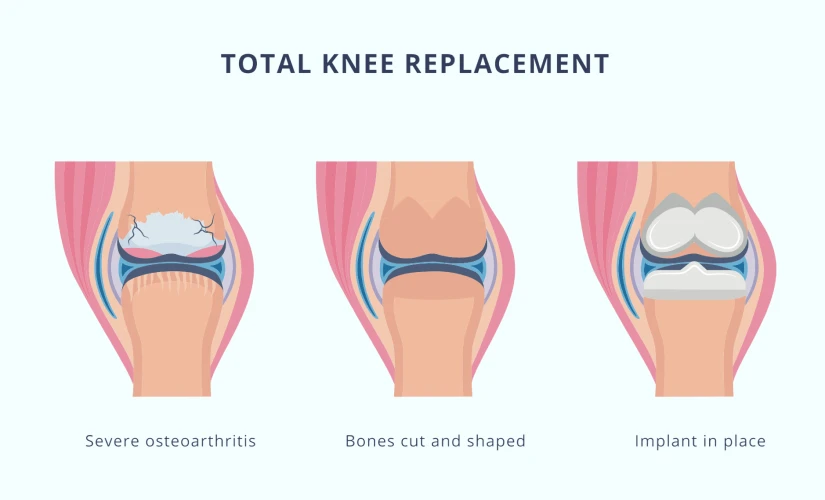
The total knee replacement procedure (TKR) is a permanent surgical technique that aims to treat chronic knee pain and regain joint function. This procedure is also referred to as the total knee replacement surgery and is advised for those patients having issues with arthritic conditions or knee joint problems. In this procedure, a knee joint is replaced by an artificial joint, which is a combination of metals, ceramics, and plastics.
Individuals facing difficulties in walking, climbing stairs, and carrying out other daily activities usually opt for the TKR procedure. This procedure is enhanced with robotic technology nowadays, and one can opt for this robotic knee replacement for a quick recovery with accurate results.
Why Choose CARE Hospitals for Total Knee Replacement Surgery?
CARE Hospitals is recognized for delivering advanced orthopedic treatment with excellent outcomes through the following:
- Advanced Techniques: We offer minimally invasive and robotic total knee replacement procedures for enhanced precision.
- Expert Orthopedic Surgeons: We have highly experienced orthopedic surgeons who are experts in performing total knee replacement surgery.
- Personalized Care: Tailored treatment plans are developed based on the patient condition, joint health, and complete lifestyle.
- High Success Rates: Our strong clinical protocols ensure safety and long-lasting results.
- Comprehensive Support: Complete support will be given from diagnosis to recovery from total knee replacement, including insurance assistance.
What is Total Knee Replacement Surgery?
Total knee replacement is a surgical procedure that is recommended to replace the entire knee joint with an artificial implant. This surgery is performed by the orthopedic surgeons when the cartilage is severely damaged, leading to pain, stiffness, and reduced mobility.
The total knee replacement procedure restores joint alignment, reduces pain, and improves function, helping patients return to normal activities.
What are the Types of Total Knee Replacement Surgery?
Total knee replacement surgery can be done by the following different approaches based on the suitability and the patient’s desire:
- Cemented TKR: This is the approach where the Implant is fixed using bone cement for stability.
- Uncemented TKR: In this approach, the implant allows natural bone growth for fixation.
- Robotic Total Knee Replacement: This approach employs advanced technology for precise alignment and improved outcomes with a shorter recovery period.
Signs You Need Total Knee Replacement Surgery & When to Consider It
A person may consider undergoing surgery for a total knee replacement if their knee pain and immobility start to affect their quality of life or how they live their life each day. Below are some of the main indications that someone may require total knee replacement surgery:
- Severe Arthritis is Damaging A Patient's Knee Joint: Osteoarthritis is advanced arthritis, which causes the patient to lose cartilage in the kneecap where it connects to the thighbone. The result is that, as the patient uses their knee joint, the surface of the thigh bone and the knee cap will rub against each other, creating chronic pain, inflammation, and progressive deterioration of the joint.
- Persistent Knee Pain is Affecting Daily Activities: Patients will continue to have pain in their knees constantly (including at night), and because of this pain, they have trouble sleeping. In addition, they have trouble doing routine daily tasks such as walking, sitting, or standing.
- Limited Ability to Move Their Joints and Stiffness of Their Joints: Patients who cannot bend or straighten their knees have limited ability to move about. If the patient has stiffness when bending or extending their knee, then the stiffness will continue to progress. Such limitations will affect their ability to be independent and their overall ability to move about.
- Non-Surgical Treatments Have Failed: If medications, physiotherapy, injection treatments, or lifestyle changes have not provided the patient with relief from their symptoms, then the next best treatment option is to have a total knee replacement.
- Chronic Pain in Their Knees When They Walk or Stand: Patients who continue to suffer from chronic pain in their knees during simple everyday activities such as walking or standing will indicate that they have significant damage to their knees and may require surgical intervention.
- Difficulty Walking Up and Down Stairs: Patients who have difficulty climbing up and down stairs generally have advanced degeneration of their knees, and surgery will become their best treatment option.
- Ongoing Swelling in Their Knees: Patients who swell their knees will continue to experience swelling and inflammation even when taking medications for their knees.
What are the Conditions Treated by TKR?
Total knee replacement (TKR) has been used effectively to treat many serious arthritic conditions of the knee. With TKR, knee function can be successfully restored when the knee joint has become severely damaged and all other treatment options, including non-surgical interventions, have failed to provide relief.
- Osteoarthritis: A degenerative condition that progressively wears away the protective cartilage of the knee joint, causing friction in the joint, decreasing the amount of cushioning between the bones, and leading to a gradual increase in the amount of loss of smoothness of motion through the knee.
- Rheumatoid arthritis: An autoimmune disease that causes a person's immune system to attack the lining of the knee joint, leading to chronic inflammation, damage to the knees, and deformity of the knee joints if not treated.
- Post-traumatic arthritis: Developed as a result of previous knee injuries such as torn ligaments/ligament ruptures or fractures. Such injuries increase the rate of wear on the knee joint and lead to long-term knee stiffness and instability.
- Severe damage due to knee injuries/fractures: Severe damage to the knee joint can cause misalignment, disruption of the knee structure, and loss of normal joint function. When a severe knee injury occurs and healing is incomplete (due to the injury's extent), it may be necessary to replace the knee joint to restore function.
What are the Benefits of TKR Surgery?
There are several benefits of TKR surgery, some of which are described below:
- Pain relief, which can be substantial, such as relief from nighttime knee replacement pain
- Increased mobility and range of motion
- Enhanced quality of life
- Sustained benefits (total knee replacement lifetime – usually 15 to 20 years)
- Rapid recovery with advanced methods
Who is a Candidate for Total Knee Replacement Surgery?
Individuals with the following criteria are eligible for total knee replacement surgery:
- Persons with severe joint damage
- Patients with limited mobility and chronic pain
- Those not responding to medications or therapy
- Typically 50–80 aged people, but depends on overall health
Total Knee Replacement Procedure (Before, During and After)
A step-by-step guide on the total knee replacement procedure, starting from preparation until after the procedure, is given below:
- Pre-Surgery
- Comprehensive assessment and diagnostic tests
- Total knee replacement procedure precautions discussion
- Optimization of health to ensure a successful surgical procedure
- During Surgery
- Use of anesthesia
- Removal of damaged bones and cartilage
- Implantation of the total knee replacement prosthetic device
- Closure with stitches
- Time taken for total knee replacement operation – average of 60–90 minutes
- Post-Surgery
- Ambulation initiated within 24–48 hours
- Total knee replacement rehabilitation exercise
- Slow return to normal activities
- Infection monitoring after total knee replacement
What is the Total Knee Replacement Recovery Time?
The duration of recovery after having a total knee replacement usually ranges from four to six weeks for performing simple activities. However, the complete recovery process might last even several months. Swelling is a frequent condition observed by patients during the early stages of their recovery. The patient must perform certain exercises to gain back his or her strength and mobility. Climbing the stairs is one of the most common questions raised by the patients post-operatively; however, it can be done within several weeks.
What are the Diagnostic Tests for Total Knee Replacement Surgery?
- Physical examination
- X-rays for joint damage
- MRI/CT scans for detailed imaging
- Stability and motion tests
Meet Our Experts
We have a team of very experienced orthopedic surgeons at CARE Hospitals, and our orthopedic specialists are proficient in carrying out the total knee replacement surgery. Our orthopedic surgeons have the best expertise in the latest technology, and this includes robotic technology, which helps them achieve accuracy during surgical operations.
Our best orthopedic surgeons in Hyderabad employ evidence-based practices and adhere to global standards to ensure patient safety and successful treatment. We take a comprehensive approach to care, meaning our orthopedic surgeons oversee each patient's journey, from initial diagnosis through post-operative rehabilitation.
Furthermore, our orthopedic surgeons collaborate with other specialists and utilize all state-of-the-art facilities and available sources to expedite healing and recovery for their patients.
Conclusion
Total knee replacement is a highly effective solution for chronic knee pain and mobility issues. With advanced techniques like robotic total knee replacement, patients experience better precision, faster healing, and long-term benefits. CARE Hospitals ensures comprehensive care from diagnosis to recovery from total knee replacement, helping patients regain an active lifestyle.
Frequently Asked Questions
Yes, it is safe and has been performed by many surgeons till date, achieving great success in terms of results.
The best hospital for total knee replacement is one that offers experienced surgeons and advanced technology; among these, CARE Hospitals ranks as one of the best to choose for the robotic knee replacement surgery.
This discomfort and pain can be caused by inflammation, muscle fatigue, or ligaments stretching; persistent pain needs immediate professional attention.
Many people start climbing stairs supported after 1-3 weeks post-surgery. Some might take more time based on their condition; age is also a major factor in this.
Many individuals can start walking with support 24-48 hours after surgery.
Most patients will experience no pain and have full mobility after a year of TKR.
Possible risks are infections, blood clots, loosening of the implant, and nerve injuries. These are the risks that might have the chance to appear, but not in every case, as seen in rare cases only.
The standard duration of the total knee replacement procedure is 60 to 90 minutes in length.
Following total knee replacement, it is recommended to engage in low-impact activities such as walking, cycling, or swimming.
The patient may receive general anesthesia, a spinal injection, or regional blocks depending on medical criteria and guidelines.
The total knee replacement consists of a prosthetic knee that has been surgically implanted into the knee cavity and consists of metal and plastic components.
Total knee replacements are considered to be major procedures; however, due to advances in surgical techniques, they are quite successful.
Patients typically need 4 to 6 weeks for an initial recovery after surgery followed by approximately 1 to 3 months for a complete healing.
Signs that a patient may have an infection following surgery include redness or swelling at the incision site, fever, unrelenting pain, drainage from the incision site, and/or any drainage from the surgical site that contains pus.
It is suggested that you have several short walks each day to promote circulation and healing.
While there are no age restrictions, eligibility depends on the individual's health and extent of knee damage.
Avoid doing high-impact aerobics, neglecting rehabilitation, and disobeying your doctor's instructions.
Yes. At CARE Hospitals, we give patients access to the related doctors who can help with their evaluations prior to and following surgery via an online consultation system.
Still Have a Question?


