



-
Centre of Excellence
Specialties
Treatments and Procedures
 HyderabadCARE Hospitals, Banjara Hills CARE Outpatient Centre, Banjara Hills CARE Hospitals, HITEC City CARE Hospitals, Nampally Gurunanak CARE Hospitals, Musheerabad CARE Hospitals Outpatient Centre, HITEC City CARE Hospitals, Malakpet
 Raipur
 Bhubaneswar
 Visakhapatnam
 Nagpur
 Indore
 Chh. Sambhajinagar
 Clinics & Medical Centers


-

-

-

-

-

-
Follow Us

Dupuytren's Contracture
Symptom, Causes, Diagnosis and Treatment
Dupuytren's Contracture (Hand Fibrosis)
Dupuytren's contracture symptoms can be subtle at first, yet this condition affects many people. The progressive hand disorder makes tissue beneath the skin thicken and tighten, which pulls fingers into a bent position that won't straighten.
Scientists have found specific inflammatory molecules that play a key role in Dupuytren's development. These include Interleukin 13 and Tumour Necrosis Factor. Their discoveries have opened doors to promising new treatments beyond the current collagenase therapy. This article covers everything from early warning signs to treatment options that help manage this challenging condition.
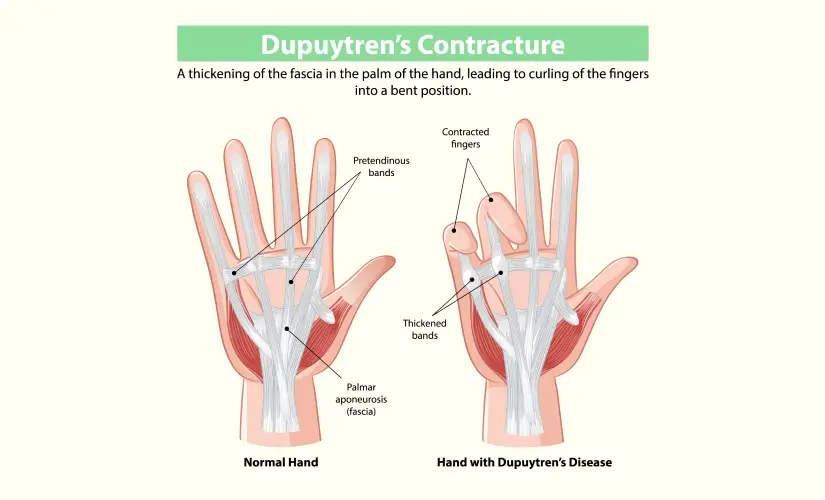
What is Dupuytren's Contracture?
Dupuytren's contracture happens when tissue under the skin of your palm becomes thick and tight. This condition targets the palmar fascia—a fibrous tissue that keeps your skin stable and protects important nerves, blood vessels, muscles, and tendons.
The fascia changes over time and creates hard lumps that turn into thick cords. These cords don't move like tendons do (tendons connect to muscles). The cords stay fixed and get tighter. Your fingers get pulled toward your palm as they contract, and you can't straighten them out anymore. The condition usually takes years to develop, so people might miss the early signs until their hand function suffers noticeably.
Symptoms of Dupuytren's Contracture
Small, firm lumps (nodules) in your palm are the first sign of Dupuytren's contracture. These nodules show up at the base of your ring or little finger. People notice these changes when:
- Their palm has small, hard bumps that stick to the skin
- The skin on their palm looks dimpled or puckered
- They can't put their hand flat on a table, palm down (the "tabletop test")
These nodules get thicker and form cords that stretch from your palm into your fingers. Your fingers end up permanently bent toward your palm in the final stage. The ring finger gets affected most often, then the little finger, and finally the middle finger. Most people don't feel pain, but some might have some tenderness, burning, itching, or mild discomfort.
Causes of Dupuytren's Contracture
Scientists haven't found the exact cause yet, but genes play a role. Dupuytren's runs in families and is passed down through an autosomal dominant pattern.
The disease has three main phases:
- Proliferative phase: Many immature myofibroblasts and fibroblasts appear
- Involution phase: Fibroblasts line up along tension lines in the hand
- Residual phase: Collagen-rich cords form with few cells, causing deformity
The condition shares some biological features with wound healing because it involves similar inflammatory molecules.
Risk Factors
Your chances of getting this condition go up with certain factors:
- Demographics: Men get it 2-3 times more often than women. The risk increases after age 40.
- Ancestry: Northern European or Scandinavian background means higher risk.
- Family history: Having family members with the condition raises your risk.
- Medical conditions: Diabetes, liver disease and epilepsy also increase risk.
- Lifestyle factors: Heavy drinking and using vibrating tools for long periods make it more likely.
Complications
Dupuytren's contracture limits what you can do if left untreated. Daily tasks become harder as the condition gets worse:
- You can't grab large objects easily
- Putting hands in pockets becomes tricky
- Handshakes get awkward
- Gloves don't fit right
- Simple tasks like washing your face or hair become challenging
- When fingers bend more than 90 degrees, skin folds can develop fungal infections because they are hard to keep clean.
The condition sometimes shows up with other problems like Peyronie's disease (penile tissue thickening), Ledderhose disease (foot fascia thickening), or Garrod's pads (thickened knuckles). These additional conditions usually mean you have a more aggressive form of the disease.
Diagnosis of Dupuytren's Contracture
Doctors can identify Dupuytren's contracture with a simple physical examination of your hands. Complex testing isn't usually needed. Your doctor will check several things:
- The location of nodules and cords on your palm
- Your fingers' range of movement
- Your fingers' and thumbs' sensation
- Clinical photographs of your hand in some cases
The tabletop test helps diagnose this condition easily at home or in clinics. Just place your hand palm down on a flat surface. Your inability to flatten your fingers completely might signal a contracture that needs medical attention.
Dupuytren's Contracture Treatment
Mild cases with minimal limitations might only need monitoring. Notwithstanding that, several treatment options exist as the contracture advances:
- Non-surgical approaches:
- Physical therapy that includes stretching exercises and heat application
- Custom splints or braces that help extend fingers
- Steroid injections into nodules to reduce pain and slow progression
- Radiation therapy with X-rays to soften cords and nodules
- Minimally invasive procedures:
- Needle aponeurotomy breaks up cords through tiny needle holes
- Collagenase injections dissolve cords before finger manipulation 1-2 days later
- Surgical options:
- Fasciectomy removes thickened tissue to free finger contracture
- Dermofasciectomy removes affected tissue and skin, often needing skin grafts
Without doubt, better outcomes come from early intervention. Treatment gets tougher, and results become less satisfactory as contractures worsen. Whatever the method chosen, Dupuytren's contracture might return (especially when you have surgery).
Low-Dose Radiation Therapy (LDRT) for Dupuytren's Contracture
Low-Dose Radiation Therapy is a targeted, noninvasive option that can help in the early or progressive stages of Dupuytren's contracture. It uses carefully measured low doses of radiation to reduce the activity of fibroblasts (cells responsible for forming the nodules and cords in the hand).
LDRT can soften and stabilize the affected tissue, slowing or even halting disease progression (especially before significant finger bending occurs). It is a painless, nonsurgical outpatient treatment performed over a few sessions and is often considered when surgery is not yet needed or as a means to prevent recurrence after other treatments.
When to See a Doctor
You should go to your doctor immediately if:
- You cannot keep your fingers completely straight.
- Simple tasks (like grasping objects) become difficult.
- Mild symptoms get worse faster.
- If contractures affect your daily activities.
- If your MCP joint contracture is more than 30°
Conclusion
Living with Dupuytren's contracture brings its share of challenges, but patients have several treatment options available. The condition responds better to early detection, which helps manage this hand disorder effectively. Most patients first spot small nodules in their palms that eventually create cords and pull their fingers toward the palm.
Getting medical advice as soon as you notice symptoms guides you toward better outcomes. Your hand function can stay intact throughout life with proper management (even though Dupuytren's contracture might return after treatment). A doctor can recommend the best approach based on your specific case, which helps you maintain your daily activities despite this challenging condition.
FAQs
1. What is the main cause of Dupuytren's contracture?
Your genes are the biggest factor, causing the majority of all cases. This condition runs in families through an autosomal dominant pattern. Several other factors can trigger or make the condition worse:
- Diabetes
- Problems with your liver
- Epilepsy
- Long-term use of vibrating tools
2. How do you prevent Dupuytren's disease?
Doctors haven't found a sure way to prevent it yet. But you can lower your risk by:
- Staying fit and working out regularly
- Taking it easy on hand-intensive activities
- Keeping an eye on your hand health
- Getting help as soon as you notice symptoms
- Adding more vitamin C to your diet
- Drinking less alcohol
3. What happens if Dupuytren's is left untreated?
One in 20 people who don't treat their Dupuytren's disease end up with finger contractures. The condition gets worse over time:
- Your hands become less useful
- Big objects become tough to hold
- You will struggle to put your hands in your pockets
- Simple daily tasks turn into challenges
- Your fingers might bend more than 90 degrees in bad cases
The condition won't get better by itself. It slowly gets worse over the years, and you'll need medical help to get your hand working properly again.

Still Have a Question?


