



-
Centre of Excellence
Specialties
Treatments and Procedures
 HyderabadCARE Hospitals, Banjara Hills CARE Outpatient Centre, Banjara Hills CARE Hospitals, HITEC City CARE Hospitals, Nampally Gurunanak CARE Hospitals, Musheerabad CARE Hospitals Outpatient Centre, HITEC City CARE Hospitals, Malakpet
 Raipur
 Bhubaneswar
 Visakhapatnam
 Nagpur
 Indore
 Chh. Sambhajinagar
 Clinics & Medical Centers


-

-

-

-

-

-
Follow Us

Partial Knee Replacement Surgery
Partial Knee Replacement Surgery
Partial Knee Replacement Surgery in Hyderabad
Partial knee replacement surgery is an advanced surgery that is advised to the patients for replacing only a specific portion of the knee joint that is affected. Unlike total knee replacement surgery, this surgery is advised to patients if the knee joint is affected by the condition of arthritis only in one particular section. Partial knee replacement surgery could prove to be beneficial for patients who suffer from knee joint problems like pain, stiffness, and restricted motion.
CARE Hospitals offer advanced partial knee replacement surgery in Hyderabad. Employing advanced surgical techniques and meticulous strategies, they aim to accelerate patient recovery, minimize discomfort, and enhance joint performance. Partial knee replacement surgery (PKR) has shorter recovery times than total knee replacement. This means that patients can get back to their normal lives faster and with less pain.
Why Choose CARE Hospitals for Partial Knee Replacement Surgery?
CARE Hospitals is one of the best hospitals for partial knee replacement surgery in Hyderabad, offering world-class orthopedic care through:
- Advanced minimally invasive and robotic surgeries
- Expert orthopedic surgeons specialized in performing joint preservation surgery
- Customized treatment plans depending on your age, condition of your joint, and lifestyle
- Successful surgeries with shorter hospital stays and quick recovery
- Transparent guidance on partial knee replacement surgery cost and insurance support
What is a Partial Knee Replacement Surgery?
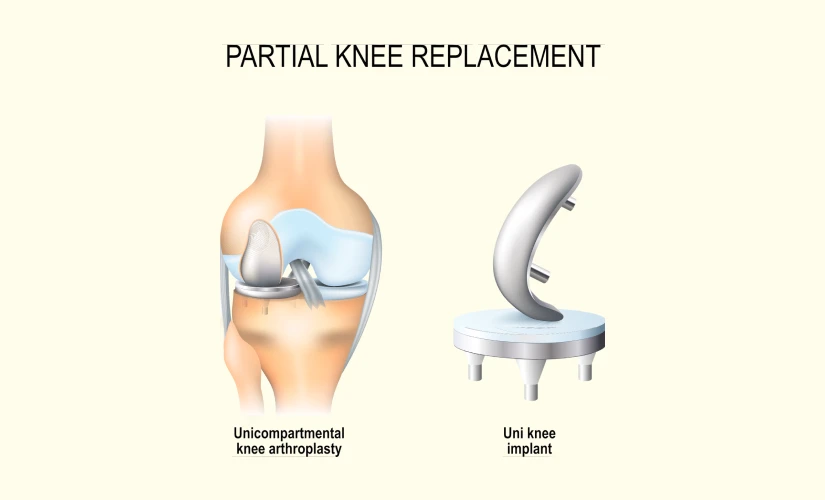
The partial knee replacement surgery is a procedure where only one compartment of the knee, which is either damaged or diseased, is replaced by an implant, while the other compartments remain untouched. Such a procedure would be most suitable for people who have knee pain caused by arthritic damage confined to just one side of the knee joint. This preserves more natural knee movement and promotes faster recovery.
Types of Partial Knee Replacement Surgery
Depending on the area of the knee joint that is affected by damage or arthritis, partial knee replacement is divided into three categories, namely:
- Medial Partial Knee Replacement: This is usually done when the problem is only in the inner part of the knee joint. This is because the inside is where arthritis usually occurs. The operation will help alleviate pain while maintaining other parts of the knee that are still in good condition.
- Lateral Partial Knee Replacement: When arthritis or any kind of damage occurs only to the outside part of the knee, then this surgical procedure is advised. This procedure will ensure the smooth functioning of the joints.
- Patellofemoral Replacement: In this surgical procedure, the kneecap and the groove that accommodates it are replaced. This is usually done when there is damage to the anterior compartment of the knee joint.
Signs You May Need Partial Knee Replacement Surgery
When the injury is confined to a particular section of the knee, partial knee replacement may be advised once the symptoms start interfering with the patient’s life. These are some of the signs indicating that the patient requires this treatment:
- Limited Arthritis Affecting One Knee Compartment: Patients with arthritis limited to one part of the knee can benefit from partial knee replacement.
- Persistent Local Pain: Should you find yourself grappling with knee pain that lingers in a specific spot, or if the discomfort persists despite trying medications, physical therapy, or injections, surgery might be the next step to find relief.
- Difficulty with Daily Activities: If knee pain is making it hard to do things like walk, climb stairs, or stand for long stretches, and this is happening regularly, it's a sign that the damage to your joint is likely getting worse.
- Reduced Mobility Due to Stiffness: If you have stiffness preventing you from bending, straightening, or moving your knee joint in an unimpeded manner, you may experience reduced independence and quality of life.
- Failure of Non-Surgical Treatments: If you have not experienced any relief through physical therapy, medications, lifestyle changes, or injections, then surgery may provide the best form of relief for your knee.
- X-ray/MRI Results Indicating Isolated Joint Damage: If you have taken imaging tests that have shown damage is only in one location of your knee, then a partial knee replacement may be an appropriate procedure for you.
- Knee Pain Preventing Sleep and Rest: If your knee pain is making it difficult for you to sleep at night or rest during the day, you should consider partial knee replacement surgery.
What Conditions Are Treated with a Partial Knee Replacement?
Partial knee replacement surgery is often used to treat the following:
- Osteoarthritis (Localized Early Stage): This condition involves the breakdown of cartilage in a single knee joint, making partial joint replacement a possible treatment.
- Localized Articular Cartilage Degeneration: This is the case where the damage occurs in just one part of the knee joint and not the whole joint.
- Partial Knee Joint Deformity: This is where there is misalignment of a part of the knee joint.
- Arthritis Due to Trauma (Localized): This is the form of arthritis due to trauma and affects only one knee joint compartment.
Benefits of Partial Knee Replacement Surgery
The key advantages are as follows:
- Small incisions with minimal tissue damage
- Shorter duration to recover from partial knee surgery
- Minimal bleeding with reduced hospitalization period
- More natural motion of knees
- Less pain and faster recovery
Who is a Candidate for Partial Knee Replacement?
Ideal patients would be:
- Those whose injury involves only one knee joint
- People whose knee joints are stable
- Those whose knee joints can move freely
- Those who do not respond to drugs or injections
Partial Knee Replacement Surgery Procedure (Before, During and After)
Partial Knee Replacement The procedure involves the following phases with pre-, intra-, and post-operative instructions:
- Before Surgery
- Physical Examination and Diagnostic Imaging
- Medical History Review and Anesthesia Assessment
- Explanation of Expectations and Recovery
- During Surgery
- Removal of damaged cartilage and bones from the affected joint area alone
- Implantation of an artificial joint in the damaged area
- The duration of a partial knee replacement procedure takes 45 to 90 minutes on average
- After Surgery
- Walking begins after 24 hours post-operation in most cases
- Physical therapy commences immediately after surgery
- Swelling and pain monitoring post-surgery
Diagnostic Tests for Partial Knee Replacement Surgery
Before undergoing the PKR surgery, doctors may recommend and perform the following tests:
- Physical examination of the knee
- X-rays for compartment damage assessment
- MRI scans for soft tissue evaluation
- Blood tests and anesthesia fitness screening
Meet Our Experts
Our orthopedic surgeons at CARE Hospitals have years of experience in conducting joint replacement surgeries. We specialize in advanced surgical techniques, including minimally invasive and robotic-assisted surgeries that enable us to precisely place implants. We provide personalized care to our patients from diagnosis to surgery, from rehabilitation to full recovery following partial knee replacement surgeries.
Conclusion
Partial knee replacement surgery is the best option for patients suffering from localized knee damage who want pain relief. The advantage is that relief can be obtained without replacing the entire joint, by focusing on a specific compartment. At CARE Hospitals, our expert orthopedic surgeons use advanced robotic technology to recommend personalized treatment approaches based on the condition, and we provide effective partial knee replacement surgery in Hyderabad.
Frequently Asked Questions
Yes, it is a safe surgical procedure when done by experienced orthopedic surgeons with excellent success rates.
Partial knee replacement surgery is a frequently performed surgery where arthritis is limited to one compartment of the knee.
The patients having arthritis in only one joint with all ligaments intact are eligible candidates.
The best hospitals for partial knee replacement surgery in Hyderabad are those with an experienced surgeon, advanced equipment, and well-facilitated operation theaters, like CARE Hospitals.
You may need the partial knee replacement surgery when you have constant knee pain and evidence of an MRI scan showing damage to only one joint.
Orthopedic surgeons with vast experience in joint replacements and handling robotic knee replacements are the best options for such surgeries. CARE Hospitals might be one like this facility to opt for.
It usually takes 45-90 minutes to complete the process of partial knee replacement.
General, spinal, and regional anesthesia could be considered on the basis of patients' conditions and doctors' advice.
Patients usually remain at the hospital for 1-3 days after their partial knee replacement surgery.
Patients usually begin to walk with help 24 hours after surgery.
It takes about 3–6 weeks for basic recovery and a few more months for total recovery after the surgery.
Yes, physiotherapy is necessary after partial knee replacement surgery, which will be recommended by the orthopedic surgeons based on the patient’s present condition.
The tests such as X-rays, MRI, blood tests, and physical assessments are typically conducted before the partial knee replacement surgery.
The walking, swimming, and cycling activities can be performed after recovering from the partial knee replacement surgery (PKR).
Preparation for the partial knee replacement will be guided by the orthopedic surgeons, which will be followed by the patient's condition, eligibility requirements, medical history review, and diagnostic evaluations using an appropriate method. Following a comprehensive evaluation, the patient will be recommended for surgery with pre-operative surgical protocols.
Yes, partial knee replacement is applicable to elderly patients in Hyderabad who have good health and localized problems in their knees.
For a partial knee replacement in Hyderabad, you should evaluate the orthopedic surgeons' experience, the hospitals' cutting-edge diagnostic equipment, the availability of robotic techniques, and the state-of-the-art operating rooms. You can choose the best hospital for your surgery based on these factors. According to the criteria mentioned, CARE Hospitals is among the top medical facilities in Hyderabad.
Still Have a Question?


