


-
Centre of Excellence
Specialties
Treatments and Procedures
 HyderabadCARE Hospitals, Banjara Hills CARE Outpatient Centre, Banjara Hills CARE Hospitals, HITEC City CARE Hospitals, Nampally Gurunanak CARE Hospitals, Musheerabad CARE Hospitals Outpatient Centre, HITEC City CARE Hospitals, Malakpet
 Raipur
 Bhubaneswar
 Visakhapatnam
 Nagpur
 Indore
 Chh. Sambhajinagar
 Clinics & Medical Centers


-

-

-

-

-

-
Follow Us


Molar pregnancies, though uncommon, can present significant challenges and confusion for women, especially since many are aware of potential pregnancy complications from the outset. This is particularly the case when the early indications of pregnancy seem perfectly normal. Early detection and appropriate treatment are crucial to safeguard a woman's health and avert future problems. At CARE Hospitals in Hyderabad, we're dedicated to providing expert, compassionate care for the safe management of molar pregnancies.
Why Choose CARE Hospitals for Molar Pregnancy Treatment in Hyderabad?
CARE Hospitals is regarded as one of the finest hospitals for molar pregnancy in Hyderabad that treats the patients with utmost care. Some of the key factors that make you choose us are
- Trusted & Expert Gynecologists for Advanced Molar Pregnancy Management
- Early, Accurate Diagnosis with Continuous hCG Monitoring
- Round-the-Clock Emergency Care for Pregnancy and Its Related Complications
- Fertility-Focused Care for Safe Recovery and Future Planning
- Personalized Treatment Plans with Long-Term Medical Follow-Up
- Compassionate, Confidential Support at Every Stage of Treatment from Diagnosis to Complete Recovery
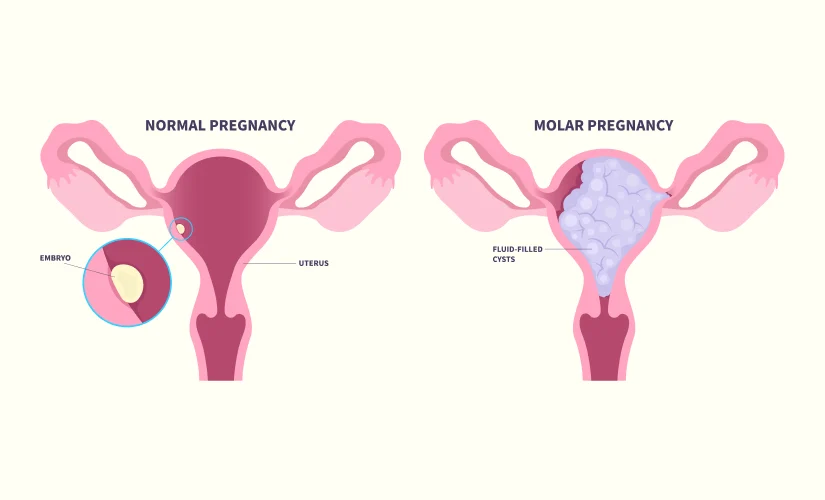
What is Molar Pregnancy?
A molar pregnancy is the condition where the uterus contains abnormal tissue instead of a normal embryo. This occurs when there are genetic errors during the fertilization process, which in turn results in the creation of pregnancy tissue that is not viable. A molar pregnancy cannot be transformed into a healthy baby, and thus it requires medical intervention to remove the abnormal tissue, and monitoring of the patient's health is vital during the recovery process.
Signs and Symptoms of Molar Pregnancy
Signs and symptoms of molar pregnancy may appear more intense or unusual compared to a normal pregnancy. The following signs are to be noticed promptly and be the basis for timely diagnosis as well as timely treatment:
- Vaginal bleeding
- Abdominal swelling
- Severe nausea and vomiting
- Rapid uterine growth
- Pelvic pain or pressure
- No fetal heartbeat
- Passing grape-like tissue through the vagina (cysts)
- High blood pressure early in pregnancy (preeclampsia)
- Signs of anemia, like tiredness, weakness, or faintness from too much bleeding
Types of Molar Pregnancy
Molar pregnancies are categorized into two types. These are explained in detail in the following:
- Partial Molar Pregnancy: In partial molar pregnancies, there is the development of an abnormal placenta and an embryo that is non-viable; this condition is mainly due to the fertilization of one ovum by two sperm, resulting in a zygote with three sets of chromosomes, which at most can not survive.
- Complete Molar Pregnancy: In complete molar pregnancies, no embryo is formed because a sperm fertilizes a vacant egg, resulting in the production of abnormal placental tissue that secretes the pregnancy hormone HCG, thus leading to a positive pregnancy test even though a viable embryo is not present.
Molar Pregnancy Reasons
The primary cause of molar pregnancy is abnormal fertilization, which leads to the improper development of the placental tissue. The causes of molar pregnancy are explained in detail in the following:
- Abnormal Chromosomal Fertilization: When an ovum without any genetic material or with an incomplete set gets fertilized, it results in the abnormal development of the placenta.
- Fertilization by Multiple Sperm: Sometimes, more than one sperm fertilizes one egg, which leads to the production of too much and abnormal tissue.
The key risk factors of molar pregnancy are as follows:
- Hormonal Imbalance: Ovulation of the molar pregnancy is sometimes associated with the risk of increased pregnancy hormone levels (hCG).
- Previous History of Molar Pregnancy: The risk of recurrence is a little higher for women who have had a molar pregnancy before.
- Maternal Age Factors: Women below 15 or above 43 are at higher risk.
Complications of Molar Pregnancy
Molar pregnancy complications will be seen in very rare cases if prompt treatment and early diagnosis are not done. The medical intervention at the right moment not only helps to eliminate the risks for the long term but also assures full recovery. The following are some possible molar pregnancy complications:
- Heavy Vaginal Bleeding: Anemia or emergency situations can occur when the abnormal placental tissue causes excessive bleeding.
- Choriocarcinoma (Rare Cancer): There is a risk of developing a malignant form of molar pregnancies that can spread to other organs, but this is observed in a small percentage of cases only.
- Persistent Gestational Trophoblastic Disease (GTD): This is the case when the mole tissue keeps on growing after treatment. Medical attention is a must in these instances.
- Uterine Infection: If the mole tissue is only partially removed, the risk of infection increases because of the tissue's presence.
- Hormonal Imbalance (High hCG Levels): This is the case that very high hormone levels lead to suffering from severe nausea, vomiting, or thyroid-related complications.
- Fertility Concerns: The delay in treatment or complications might have a temporary effect on one's future pregnancy planning.
Diagnosing Molar Pregnancy
Early diagnosis of molar pregnancy is very important, as one should get the pregnancy-related health checkups on a regular basis in order to avoid complications and to apply treatment promptly. The doctors usually make the diagnosis by the combination of the following clinical assessments, imaging and laboratory examinations:
- Pregnancy Test (hCG Levels): The suspicion of a molar pregnancy is raised if the levels of hCG hormone are found to be abnormally high.
- Physical Examination: The size of the uterus may be larger than what is expected for the pregnancy stage.
- Ultrasound Scan: A pelvic ultrasound reveals typical signs, e.g., a “cluster of grapes” appearance and no normal fetus.
- Blood Tests: Further blood tests provide information about the patient’s health, including anemia and thyroid function.
- Histopathological Examination: The tissue that is dissected during the operation is subjected to microscopic examination to confirm the diagnosis and determine the type of molar pregnancy.
Molar Pregnancy Treatment
A molar pregnancy is treated by a careful and prompt treatment plan to get rid of non-cancerous tissue and to prevent serious complications. The method of treatment is based on the molar pregnancy type, hormone levels, and the patient’s general health and future fertility plans.
- Dilatation and Curettage (D&C): The most common and preferred treatment, where abnormal molar tissue is gently removed from the uterus.
- Vacuum Aspiration: A safe suction-based method often used along with D&C to completely clear molar tissue.
- Medication Support: In certain mild situations, medication is advised in place of surgery to help your uterus contract and expel its contents. Additionally, medications may be recommended to ease uterine contractions and lessen bleeding after tissue removal.
- Hysterectomy: Recommended in selected and rare cases for women who have completed childbearing or have a high risk of persistent disease.
- Chemotherapy: Chemotherapy is recommended in some cases if molar tissue persists or develops into gestational trophoblastic disease, based on rising hCG levels.
- Regular hCG Monitoring: Ongoing blood tests after molar pregnancy treatment ensure all molar cells are cleared and help detect recurrence early.
- With timely treatment and proper follow-up, most women recover completely and can plan future pregnancies safely.
Conclusion
A molar pregnancy needs an early diagnosis, proper treatment, and regular follow-ups to fully recover. At CARE Hospitals, Hyderabad, our professional obstetricians and gynecologists give thorough treatment and long-term care to help manage molar pregnancy safely and let the patients heal physically and mentally. Getting medical care early is the main factor in getting the best results.
Our Doctors
-

Dr. Aditi Laad
MBBS, DNB
Woman & Child Institute
View More
-

Dr. Chetna Ramani
MBBS, DGO
Woman & Child Institute
View More
-
Dr. Sushmita Mukherjee Mukhopadhyay
MBBS, DGO, MD, DNB, FICOG
Woman & Child Institute
View More
-

Dr. Neena Agrawal
MBBS, MS, FICOG, Diploma in Gynaecology, Endoscopy
Woman & Child Institute
View More
-

Dr. Abhinaya Alluri
MS (OBG), FMAS, DMAS, CIMP
Woman & Child Institute
View More
-

Dr. Alakta Das
MBBS, MS (O&G), FMIS
Woman & Child Institute
View More
-

Dr. Alka Bhargava
MBBS, MS
Woman & Child Institute
View More
-

Dr. Amatunnafe Naseha
MBBS, DNB, FRM
Woman & Child Institute
View More
-

Dr. Aneel Kaur
DGO
Woman & Child Institute
View More
-

Dr. Anjali Masand
MBBS, MD (OBG)
Woman & Child Institute
View More
-

Dr. Arjumand Shafi
MBBS, DGO
Woman & Child Institute
View More
-

Dr. Kranthi Shilpa
MBBS, MS (ObGyn), FRM, Fellowship in Infertility
Woman & Child Institute
View More
-

Dr. Krishna P Syam
MBBS, DGO, DNB
Woman & Child Institute
View More
-
Dr. Neha V Bhargava
MS, DNB (obgyn), MNAMS, Fellow (Gynae Oncology)
Woman & Child Institute
View More
-

Dr. Prabha Agrawal
MBBS, MD, FMAS, FICOG, Fellowship in minimal access surgery
Woman & Child Institute
View More
-

Dr. Prathusha Kolachana
MBBS, MS (Obstetrics and Gynecology), Post-Doctoral Fellowship in Endogynecology (Laparoscopy)
Woman & Child Institute
View More
-

Dr. Ruchi Srivastava
MBBS, DGO, DNB
Woman & Child Institute
View More
-

Dr. Sindhuri Gorantla
MBBS, MS(Obgyn, Gold Medalist), FICOG(Rep.Medicine), FMAS, Diploma in ICCG
Woman & Child Institute
View More
-

Dr. Sonal Lathi
MBBS, MD, DNB
Woman & Child Institute
View More
-

Dr. Sushma J
MBBS, MS (OBG)
Woman & Child Institute
View More
-

Dr. Thajammul Samrin
MBBS, MS, FICOG, FMAS
Woman & Child Institute
View More




















Frequently Asked Questions
Couldn’t find what you were looking for?
Need any help? Get a Call Back.

Still Have a Question?


