
Centre of Excellence
Specialties
Treatments and Procedures
Hyderabad
Raipur
Bhubaneswar
Visakhapatnam
Nagpur
Indore
Chh. Sambhajinagar
Clinics & Medical Centers
Online Lab Reports
Book an Appointment
Consult Super-Specialist Doctors at CARE Hospitals
Updated on 22 July 2026
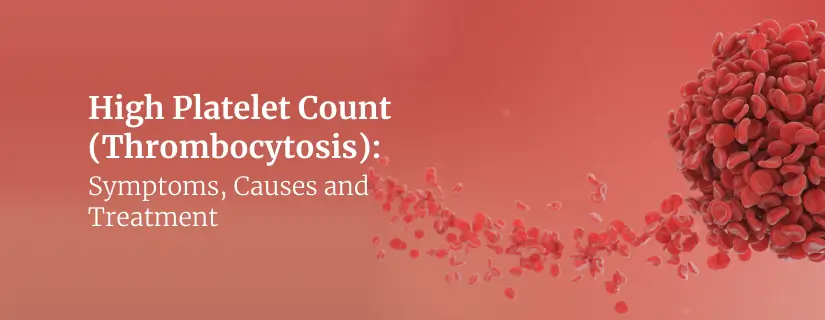
A high platelet count is usually detected by accident on a routine blood test. Most of the time it's reactive - the body responding to something else going on and it settles down on its own. A smaller number of cases come from a problem in the bone marrow itself, where platelets are being overproduced independently. Telling these two apart matters because it changes what investigation and treatment, if any, are needed.
Mildly raised counts are almost always reactive and nothing to worry about. Counts that stay high for no obvious reason need checking. And very high platelet counts can actually raise bleeding risk rather than clotting risk. This article explains high platelet count causes, symptoms and treatment options.
The key distinction is between reactive thrombocytosis and a bone marrow disorder. Both end up with a high platelet count, but for very different reasons, with very different implications.
Reactive thrombocytosis is by far the most common type. The body releases signalling chemicals in response to infection, inflammation, surgery, or injury, and these chemicals tell the bone marrow to make more platelets.
Iron deficiency is a particularly common trigger - the exact reason isn't fully understood, but it's a well-recognised pattern.
Other common triggers include infections, inflammatory conditions like rheumatoid arthritis or inflammatory bowel disease, recent surgery, and cancer. The good news with reactive thrombocytosis is that it doesn't carry extra clotting risk on its own and the count comes back down once the underlying problem is treated.
The other category is a bone marrow disorder where platelet-producing cells multiply on their own, without an external trigger. Essential thrombocythaemia is the most common cause of this type. It happens because of a mutation in the bone marrow cells (most often in a gene called JAK2) that makes them overproduce platelets regardless of what the body needs. Many related bone marrow conditions can also cause high platelets.
People who have had their spleen removed often see a sharp rise in platelet count afterwards. The spleen normally filters out old platelets, so without it the count goes up.
Most people with reactive thrombocytosis have no symptoms at all - it's just a number on a blood test. When symptoms do appear, they're usually a sign of the bone marrow type rather than the reactive type. Common symptoms are:
The first step is a full blood count along with a look at the blood under a microscope. This shows unusual-looking platelets, clumping, and changes in red blood cells that can point toward iron deficiency or a bone marrow problem.
If a bone marrow disorder is suspected the next step is genetic testing, usually starting with the JAK2 mutation. If that's positive alongside a high platelet count and a fitting clinical picture.
A bone marrow biopsy is still sometimes needed to determine the cause of the high platelet count, particularly if an underlying blood disorder is suspected. Iron levels and markers of inflammation help rule out reactive causes.
An ultrasound scan of the spleen is also useful - an enlarged spleen points more toward a bone marrow disorder, while a normal-sized one fits better with a reactive cause.
If a clot in an unusual location is suspected, specific scans of those blood vessels are arranged.
Reactive thrombocytosis doesn't need treatment aimed at the platelets themselves. Treating whatever is causing it (the infection, the iron deficiency, the inflammatory condition) brings the count back down on its own.
Treatment for the bone marrow type depends on a person's overall risk. People who are younger, have no history of clots, and don't have a particularly high-risk mutation are usually managed with low-dose aspirin alone. People at higher risk due to older age, a previous clot, an extremely high count, or other cardiovascular risk factors usually need additional medication to bring the platelet count down.
Common complications are:
For most people who get a high platelet result, the right next step is to look for a reactive cause rather than worry - checking iron levels, inflammation markers, and recent illness will usually explain it. Once that underlying issue is treated, the platelet count typically follows it back down.
When it turns out to be the bone marrow type, decisions about treatment depend on a fuller picture including age, the specific mutation involved, past clots, and other health risks - not the platelet number on its own. That's a judgement best made by a haematologist, not something to work out from a single test result.
There's no single cut-off number that applies to everyone. The same count can mean very different things depending on the cause, the person's age, and their other health risks. What matters most is why the count is high, not just how high it is. At the very extreme end, the risk actually shifts from clotting toward bleeding.
Reactive thrombocytosis is the body's normal response to something else like an infection, inflammation or low iron and it goes away once that's treated. Essential thrombocythaemia is different: it's caused by a mutation in the bone marrow itself, so the overproduction continues regardless of what else is going on, and it needs ongoing management rather than resolving on its own.
If the cause is something reactive and treatable like iron deficiency or an inflammatory condition then yes, fixing that underlying problem will usually bring the count down within a matter of weeks. For the bone marrow type, lifestyle changes won't affect the platelet count itself, but looking after general cardiovascular health (not smoking, managing blood pressure) still matters because it lowers the overall risk of clots.
A mild rise in platelet count is common in normal pregnancy and is not a concern. Someone who already has a bone marrow platelet disorder and becomes pregnant needs specialist care throughout, as described above. Any unexplained high platelet count in pregnancy is worth getting checked.
To Book an Appointment, call:
Low Potassium (Hypokalemia): Symptoms, Causes, Treatment and Home Remedies
HeartBurn: Symptom, Causes, Risks and Treatment
22 July 2026
22 July 2026
22 July 2026
22 July 2026
21 July 2026
21 July 2026
31 March 2026
31 March 2026
Have a Question?
If you cannot find answers to your queries, please fill out the enquiry form or call the number below. We will contact you shortly.
Get A Call Back From Our Health Advisor Now
Enter your details, and our advisor will call you back shortly!
Thank You!
Our health advisor will get in touch with you shortly.